Street Food 2026: How to Turn a Food Cart or Coffee Bike into a Profitable Mobile Business with BizzOnWheels
By 2026, street food has become one of the smartest opportunities in the food and beverage world. While traditional restaurants still get most of the attention and investment, the real growth is happening with compact food carts, coffee bikes, and mobile kiosks moving through office areas, shopping centers, and waterfronts. The global street food and gourmet street food markets are expected to grow steadily this decade, as more people choose flexible, on-the-go dining over traditional sit down meals. Meanwhile, opening a brick-and-mortar restaurant can cost anywhere from about $95,000 to over $2 million when you include rent, build out, and permits, making it hard for many new founders to get started. In this environment, a well designed BizzOnWheels food cart or bike gives you a lower-risk, flexible way to test your idea, build your brand, and plan for the future.

With the right mobile setup, you can test your idea with real customers, build a strong social media presence, and grow into a small fleet, often for much less money than opening a single café. Recent reports show that the food truck and food cart markets are worth billions and are growing fast, especially among younger people who want new dining experiences instead of formal restaurants. BizzOnWheels offers more than just custom food carts and coffee bikes, it gives founders the flexibility to start small, stay adaptable, and expand only when it makes sense.
1. What Street Food Really Means in 2026
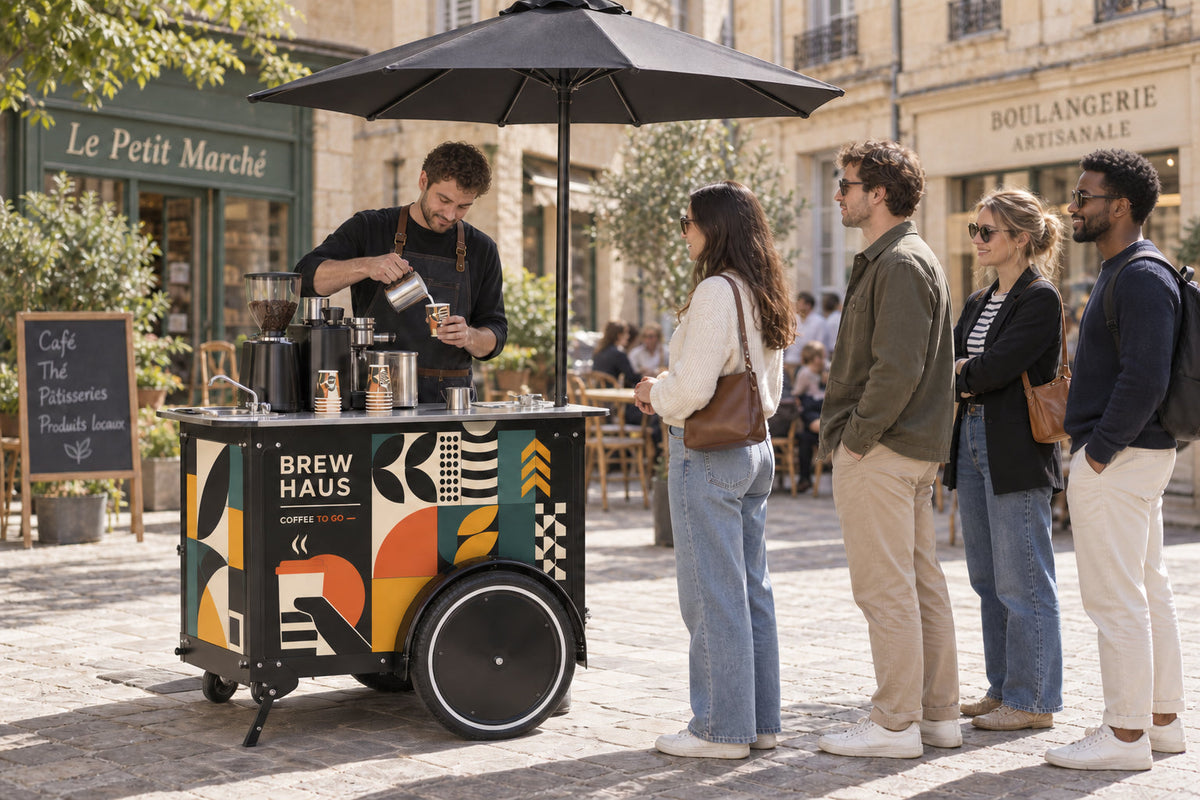
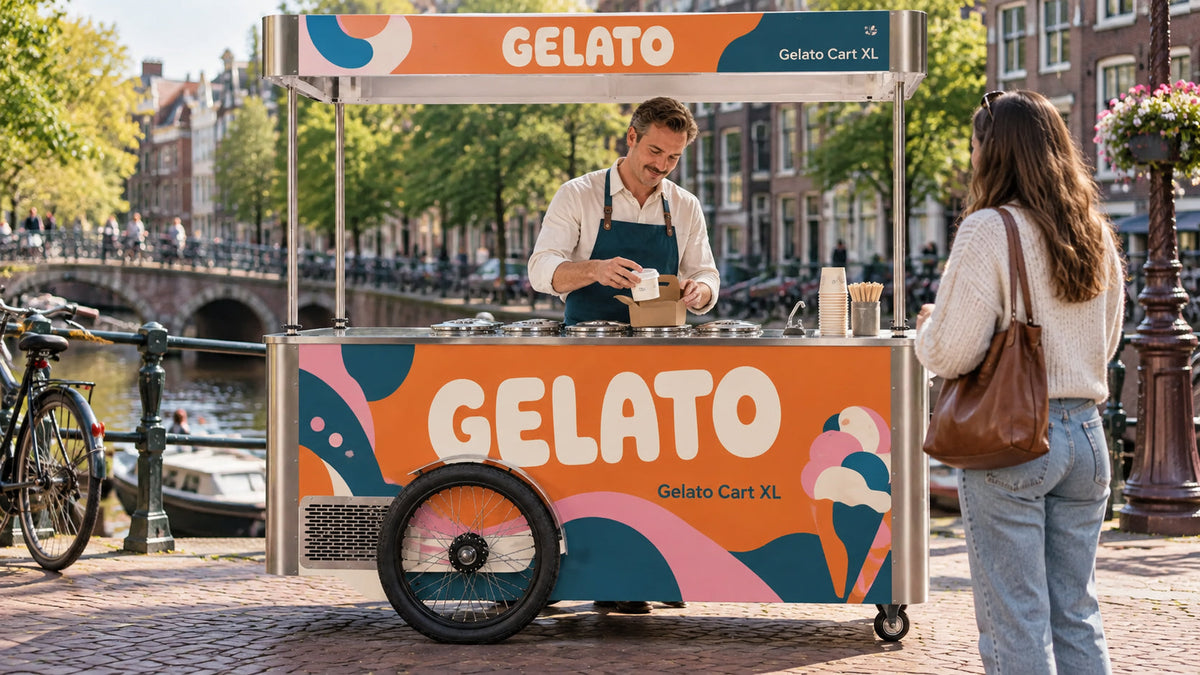
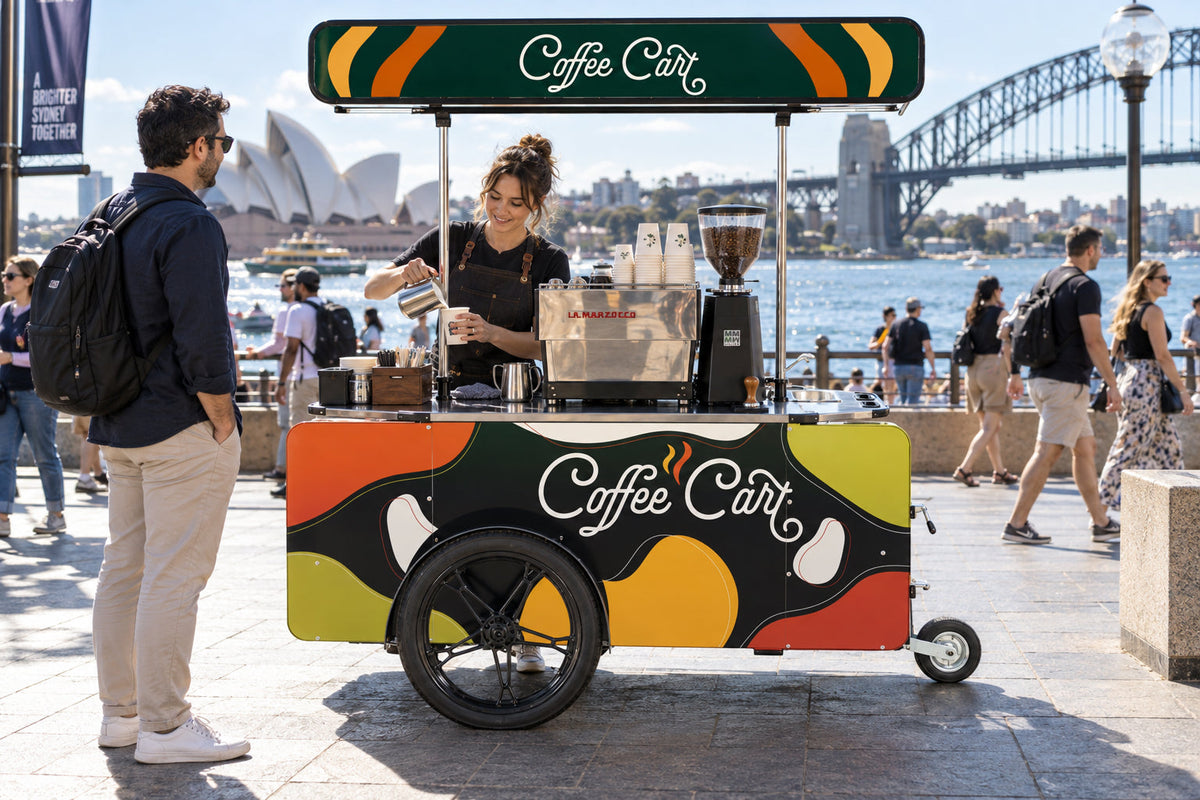
The old idea of street food as just a burger van at a muddy festival is out of date. By 2026, street vending has become a mobile ecosystem, offering everything from specialty coffee to chef quality hot snacks, all from small setups. In any European city, you’ll find food carts serving coffee to office workers, gelato carts on promenades, juice and lemonade carts for families, and gourmet toasties made to look great on Instagram. This isn’t just a trendt, the global street food and gourmet street food markets bring in over $300 billion each year and are expected to keep growing through 2030, as more people in cities look for quick, convenient meals.
These businesses succeed where people are on the move, not just where buildings are located. Corporate campuses, busy office areas, malls, transit hubs, university quads, and tourist spots are now top locations for mobile food carts. Mobility isn’t just about location, it’s also about timing. A coffee bike might serve commuters at a train station in the morning, move to a university at lunch, and show up on a waterfront in the evening, all without needing a long-term lease. Street food operators now see cities as changing maps of demand, moving their carts to where the crowds are instead of waiting for customers to come to them.
2. Why the Category Keeps Growing
The financial story behind this boom is straightforward. Launching a full-service restaurant still routinely demands six figure and sometimes seven figure capital outlays, particularly the financial reasons for this growth are clear. Opening a full service restaurant still usually costs hundreds of thousands, or even millions, once you add up build out, furniture, permits, and working capital. In comparison, a typical food truck costs about $50,000 to $250,000, depending on the setup, and food carts or bikes can be even cheaper, especially if you don’t need a full truck. This big difference in startup costs is why food trucks and carts, now worth billions worldwide, are growing faster than many traditional restaurants, with forecasts showing steady growth into the 2030s. that roughly three quarters of people now use social media to decide where to eat, while around 40% say they have tried a restaurant specifically because of food photos they saw online. For Gen Z and younger millennials, platforms like Instagram and TikTok have leapfrogged traditional guides and review sites, one recent survey found that a clear majority of younger diners had visited a restaurant in the last three months based on a social media review. Street food concepts, with their highly visual hero products and compact, photogenic setups, are tailor made for this environment. A single espresso tonic poured over ice in a minimalist BizzOnWheels coffee cart can generate more user generated content in a day than a mid market restaurant might see in a week.

3. The Sustainability Edge of Food Bikes
Beyond cost and flexibility, another force is reshaping mobile food: decarbonization. As European cities tighten emissions standards, restrict car access to historic centres and experiment with low traffic neighbourhoods, the logic of running your business besides cost and flexibility, decarbonization is also changing mobile food. As European cities set stricter emissions rules, limit car access to historic areas, and try out low traffic zones, running a business with a diesel van is becoming less practical. Studies show that electric cargo bikes can deliver more parcels per hour than vans in busy city centers, with one well known study finding that cargo bikes made about 60% more deliveries per hour than vans on similar routes. E-cargo bikes can cut greenhouse gas emissions per kilometer by 90–98% compared to diesel vans, and they even outperform electric vans on key environmental measures. ESG oriented malls or corporate campuses under pressure to demonstrate sustainable procurement, the difference between a van and a bicycle towed espresso bar can be decisive. In practice, a food bike glides into pedestrian squares, parks, and courtyards where vehicles are banned, without conflict, and leaves behind only the scent of coffee or grilled sandwiches rather than exhaust. That combination, access, optics and measurable carbon savings turns mobility itself into a competitive advantage.

4. Choosing Your Platform: Cart, Bike or Both?
The choice between a food cart and a food bike is less about which one is “better” and more about how you plan to trade. A well designed food cart is, in essence, a compact micro kitchen on wheels. BizzOnWheels builds its carts in three core sizes: M, L, and XL, so operators can match the footprint to the menu and location. The smaller M format lends itself to coffee and espresso, grab-and-go snacks in tighter corridors and lift only access zones. The L size balances storage, worktop real estate and maneuverability for busier mall pitches or medium volume juice and lemonade concepts. The XL platform is the workhorse for operators who need more cold storage, more prep space or hot food setups that still comply with hygiene and safety rules.
What matters is the underlying engineering. All BizzOnWheels cart formats are designed to function both as push carts and as bicycle towed units, which means you effectively own one chassis that can work in a shopping mall during the week and on a festival field on the weekend. The proprietary tow system, with its motorcycle-grade central wheel and hydraulic brakes, is designed to keep the unit stable over cobblestones, curbs, and uneven surfaces, even when fully loaded with water, ice, and refrigeration equipment. In an industry where many “converted” trailers and DIY carts are little more than retrofitted shells, this kind of purpose built stability matters for both safety and insurance.
Food bikes sit one step further along the mobility spectrum. When you mount a BizzOnWheels cart or a dedicated food bike, you effectively turn your unit into a moving billboard. A brightly branded coffee bike rolling through a historic centre or across a university campus exposes your logo to thousands of impressions a day without buying a single advertising slot. Recent analyses of the global food truck and cart market show brands increasingly using mobile units not just as revenue machines but as roving experiential marketing assets, sampling, brand activations, seasonal tours and limited time collaborations. A modular platform that can switch from weekday retail to weekend activation is exactly where BizzOnWheels has positioned itself.
5. Designing a Niche That Pays Its Own Rent
The romance of street food can obscure a basic truth: your menu is a piece of industrial design. It needs to be simple enough to execute at speed with a small footprint, consistent enough to maintain high quality in peak hours, and profitable enough to pay for the cart, the pitch, and the people behind it. Across Europe and North America, the most successful mobile concepts tend to cluster around a few high-leverage niches: coffee and espresso, gelato and ice cream, fresh juices and lemonades, gourmet sandwiches and toasties, and hot snacks adapted to local tastes and venting constraints. These align neatly with broader foodservice trends, where consumers increasingly favour convenient, snack like occasions and premiumized “small treats” over formal three course meals.
From an operational point of view, the sweet spot is usually a menu that you can prepare in 60 to 90 seconds per order during peak trade. A BizzOnWheels coffee cart, for example, might focus on a tight core of espresso based drinks, supported by a few carefully chosen extras, alternative milks, syrups, cold brew on tap,rather than sprawling into thirty different SKUs that slow the barista down. In ice cream or gelato, the same logic applies: a small number of base flavours plus toppings and sauces that create the perception of variety while keeping prep streamlined. The goal is to design clear “upsell ladders” bigger sizes, extra shots, premium toppings so that each transaction has headroom without adding complexity at the workstation. Price for margin, not for parity with the cheapest competitor on the street, when your service is fast, and your experience is memorable, customers will pay a premium for convenience and quality.
6. Budget and ROI: Turning Throughput into Payback
The easiest mistake new operators make is treating a food cart as a lifestyle project rather than as a cash flow engine. The math, however, is refreshingly tractable. Industry benchmarks suggest that even conventional food trucks, with full vehicle costs, often break even at modest daily transaction counts, purpose built carts and food bikes, which require less investment, can reach viability with even fewer sales assuming the menu and pricing are well thought through.
Start with your peak hour throughput. Suppose a weekday coffee cart using a BizzOnWheels L platform can produce 40 drinks an hour for four strong trading hours—morning and lunchtime peaks. That yields 160 drinks a day. At an average ticket of €3.50, including extras and occasional food add-ons, you are looking at €560 in gross revenue per day. If your cost of goods, the coffee, milk, syrups and basic disposables, runs at roughly 28%, that’s about €157 gone in ingredients. Add a daily equivalent for your pitch fee, say €60, labour for one and a half full-time equivalents at around €130, and miscellaneous costs for power, transport and extra disposables at €40. Your net, in this simplified model, comes to roughly €173 per day, or between €3,500 and €4,000 per month on a 20–23 day operating schedule.
From there, payback becomes a design decision. If your fully equipped BizzOnWheels coffee cart and espresso setup costs, for the sake of argument, €5,000–€9,000, then a stable €3,500–€4,000 monthly net could, in theory, repay the investment in 2-4 months before tax and overhead. Your job as an operator is to stress test these numbers: model weekdays versus weekends, high season versus low season, and events versus regular pitches. Because BizzOnWheels platforms can be bicycle towed, you can also meaningfully reduce fuel and parking costs, which increasingly matter as city centres roll out congestion charges and low emission zones.
7. Building a Safe, Compliant Micro-Kitchen
No matter how small your footprint, the moment you serve food to the public, you become a food business in the eyes of regulators. In the European Union, the central reference point is Regulation (EC) No 852/2004 on the hygiene of foodstuffs, which requires all food business operators, including mobile units, to apply general hygiene rules and implement procedures based on the principles of Hazard Analysis and Critical Control Points (HACCP). National agencies such as the Food Safety Authority of Ireland, as well as local authorities in countries from Slovakia to the Netherlands, publish simplified guidance packs to help small operators implement HACCP for food trucks, market stalls, and gastro trailers.
Conceptually, HACCP is simple: you identify where things can go wrong in your process, define “critical points” such as cooking, cooling, or cold storage, set limits for those points, and monitor and document that they are being respected. In a BizzOnWheels coffee cart, that might mean specifying regular checks of fridge temperature and ensuring that the hand wash basin has cold running water, soap, and hygienic drying facilities at all times. In an ice cream cart, you will carefully consider the display freezer, backup storage, scoop washing, and toppings handling. For juice and lemonade concepts, you will focus on washing and preparing fresh produce, managing ice, and preventing cross contamination. Hot snacks introduce an additional layer: planchas, grills or fryers must be paired with appropriate ventilation, fire safety equipment and, where gas is used, gas safety checks.
The advantage of working with a specialized manufacturer is that the cart itself is engineered to support these workflows. BizzOnWheels platforms are designed to integrate hand wash modules, fresh and grey water tanks, refrigerated storage, power solutions from mains hookups to solar, battery and inverter systems, easy-to-clean surfaces. The result is a micro kitchen that behaves like a compliant, inspectable premises even though it can be wheeled through a corridor or towed behind a bicycle.
8. Licences, Notifications and Navigating EU Red Tape
If HACCP governs how you operate, local licensing regimes govern where and under what conditions you can trade. Across the EU, the pattern is broadly consistent even though the details vary by country and municipality. Food truck and food cart operators are generally required to register their food business with the competent local authority before starting operations, often at no charge, and to declare that they comply with hygiene rules under Regulation 852/2004. On top of that, you may need a specific street trading licence, a market stall permit, an authorization to operate at festivals, or a private site agreement for malls and corporate campuses. Guidance from Dutch and Belgian authorities, for example, explains how food truck founders must reconcile labour, tax, food safety and municipal vending permits before hitting the road.
BizzOnWheels has documented many of these pathways in its own guide to food cart licences and permits across Europe, walking prospective operators through the steps for countries such as Denmark, where you register with the food administration and obtain an annual street vending permit from the Danish Business Authority. Elsewhere, UK-focused resources outline the need for street trading consent, public liability insurance and proof that your vehicle or stall meets minimum build standards. The point is not to memorize every rule in advance; it is to understand the logic. Authorities want to know who you are, what you sell, how you keep food safe, and where you intend to trade. Once you see it through that lens, the paperwork becomes manageable and in many cases, surprisingly fast.
9. Location Strategy: Where Carts and Bikes Win
In street food, the right concept in the wrong place will fail, an average concept in the perfect spot can quietly mint money. Mobile formats excel in what might be called high-footfall, low-friction zones: places where people already pass in large numbers, where access is straightforward and where a compact unit can slot into existing flows without requiring heavy infrastructure. Commuter nodes such as train and metro stations, busy bus interchanges and office corridors are natural fits for coffee and breakfast items. University campuses reward affordable price points and generous portions. Tourist promenades and waterfronts lend themselves to ice cream, lemonade and light snacks, especially in warm seasons.
Indoor environments are different but equally attractive. Food carts are uniquely suited to shopping malls, airports, and transit hubs, where traditional trailers cannot navigate narrow corridors or elevators. A BizzOnWheels M or L cart can be rolled into position before opening hours, trade throughout the day, and then be wheeled into back-of-house storage at night. For landlords, this kind of plug-and-play tenant offers animation without construction; for operators, it offers protected footfall and weather proof revenue.
Then there are events. Music festivals, sports fan zones, street fairs, weddings and corporate activations are where food bikes and bike towed carts show their full potential. Because they are not tied to vehicle access routes, a BizzOnWheels food bike can reposition within the same event moving closer to the main stage before a headline act or closer to entrance gates at peak arrival times. The same attributes that make cargo bikes more efficient than vans for last-mile deliveries in congested cities speed, maneuverability and minimal parking constraints apply just as well to a coffee bike weaving through a crowd. In a world where tenders increasingly include sustainability criteria, being able to serve an entire fan zone from bicycle-towed units is not just a novelty; it is a line item in your competitive advantage.
10. Branding, Menu Engineering and Content That Sells
In a market where almost three-quarters of diners say they use social media to decide where to eat, the distinction between operations and marketing has blurred. Your cart or bike is not merely a workstation, it is the set for your content. The most effective mobile brands, therefore, build around a “hero product” that photographs well and signals the concept at a glance: a distinctive espresso tonic in a tall, transparent cup, a visually extravagant gelato creation piled with colour, a layered lemonade in branded glassware. When that product is served from a clean, well-designed BizzOnWheels cart with strong lines, thoughtful lighting, and a disciplined colour palette, every transaction becomes a potential post.
Experiential marketing research shows that brand activations, which let people touch, taste, and test products in person, can generate significantly higher ROI than traditional digital campaigns, with some analyses citing an impact up to 4 times that of traditional digital campaigns when the experience is well-designed and properly measured. A coffee bike stationed at a corporate headquarters, offering free samples for employees in exchange for social tags or email sign-ups, is simultaneously a revenue stream, a sampling campaign and a content engine. Data from event marketing firms suggests that a majority of consumers now post about experiential activations on social media, amplifying brand reach far beyond the physical footprint. Mobile carts, by design, live at the intersection of taste and shareability.
Menu engineering plays directly into this flywheel. A focused core menu keeps operations tight; optional extras and bundles, coffee plus pastry, lemonade plus snack raise the average ticket. Seasonal specials act as natural content hooks and encourage repeat visits. Clear, attractive allergen information and prominently displayed hygiene credentials, prominently displayed on the cart, build trust in an era when customers are increasingly vocal about safety and transparency.
11. A 90-Day Blueprint: From Idea to First Revenue
Transforming a sketch in a notebook into a trading food cart in under three months is ambitious but entirely achievable if you treat the process as a series of sprints rather than one monolithic project. The first two weeks are foundational. This is where you choose your niche,coffee, gelato, juices, hot snacks, and map it against your local market. You speak to landlords or event organizers, check local requirements for food business registration and street trading, and begin drafting a simple HACCP plan based on national guidance packs. It is also where you decide on your platform: M, L or XL BizzOnWheels cart, bike towed or static, mains power or solar-battery and inverter.
The next fortnight is about prototyping and supply. You refine your menu to a handful of items you can prepare consistently in under 90 seconds; you source coffee, dairy, syrups, or base products; and you make sure your equipment layout allows one or two people to work without crossing paths. This is the time to choose your disposables, uniforms and point-of-sale solution, and to ensure that your cart configuration supports your HACCP plan,from hand wash to cold chain.
Days 31 to 60 belong to the market. You run soft launches in two or three different locations, a weekday office district, a weekend promenade, perhaps a university campus and you treat them as experiments. You track footfall per hour, conversion rate, average ticket size and product mix. You adjust pricing and menu items based on real world feedback rather than on assumptions. You standardize prep, service and cleaning procedures into checklists that anyone on your team can follow.
From day 61 onwards, you shift from exploration to exploitation. You lock in recurring pitches weekday coffee slots outside an office, weekend presence at a farmer’s market or along a popular promenade. You build an events calendar, identifying festivals, corporate events, and private bookings that align with your niche. If the numbers look healthy and your processes are repeatable, you start planning your second unit: another BizzOnWheels cart configured for a complementary niche or geography.

12. A Mini Coffee Cart P&L in Practice
Abstract ROI models only become real when translated into daily line items. Take the earlier example of a weekday coffee cart producing 160 drinks a day at an average ticket price of € 3.50. On paper, the €560 daily gross and roughly €173 estimated net after cost of goods, pitch, labour and miscellaneous expenses point to an annualized profit in the mid five figures for a single cart on a five day week. But these numbers are sensitive. A small increase in average ticket, through better bundles or premium options, can meaningfully lift daily net. A poorly negotiated venue fee or under utilized staff can erode it just as quickly.
The role of the cart manufacturer is to give you a platform that does not constrain your economics. A BizzOnWheels cart that can operate indoors during the week and be bicycle towed to paid events at weekends expands your revenue surface area without requiring a second set of equipment. Conversely, a poorly constructed unit with awkward ergonomics or unreliable power will drag down throughput precisely when you need it most. The mini P&L is, therefore, less a forecast than a stress test. It tells you what has to be true about your volume, pricing and cost structure for your mobile business to be worth the time and capital you invest.
13. From One Cart to a Fleet: A Composite BizzOnWheels Story
Consider a composite founder let’s call him Alex, who decides to leave a corporate job and start with a single BizzOnWheels L coffee cart in a mid sized European shopping mall. He negotiates a sensible pitch fee in exchange for trading rights in a high traffic corridor and configures his cart with a two group espresso machine, grinder, milk fridge, integrated hand wash and under counter storage. Within a few months, he has refined his menu to a tight list of espresso drinks and a rotating guest beverage, and he is consistently hitting 75 to 100 drinks an hour at peak lunch and weekend times.
Seeing demand beyond the mall, he adds bike tow capability to the same cart, allowing him to move the unit to outdoor events on weekends without investing in a truck. The motorcycle grade wheel and hydraulic braking system stabilize the cart over cobblestones and curbs, even when fully loaded with water and refrigerated stock, so he can trade confidently at waterfront festivals and street fairs. As his brand grows on social media, he notices that flat lay shots of his cart in different locations generate as much engagement as his drinks.
By month four, Alex adds a second unit: a compact BizzOnWheels M cart configured for lemonade and fresh juices, targeting summer events and family oriented promenades. The original coffee cart becomes his weekday anchor in the mall, while the lemonade cart becomes a flexible activation platform for festivals, pop-ups, and corporate bookings. By month nine, he effectively runs a micro fleet: coffee in the mall and at corporate campuses, lemonade at festivals and on promenades, and both units available for private events. At that point, he begins to model an XL hot snacks cart perhaps loaded with gourmet toasties or flatbreads to raise his average revenue per customer and deepen his presence at evening events.
The details will differ for every founder, but the pattern recurs across markets: start with one focused, profitable unit, use mobility to find your strongest pitches; reinvest into a small fleet, and if it makes sense, translate that proven mobile brand into a permanent site later.
14. Four Questions Every New Operator Asks
The first question is almost always about food safety: Do you really need a HACCP plan for a food bike or food cart? In the EU, the answer is yes. Regulation 852/2004 does not distinguish between a bricks-and-mortar restaurant and a mobile cart, both are expected to implement HACCP controls, though many national authorities offer simplified packs for very small operators.
The second question concerns the unit's hygiene facilities. In practice, regulators expect at least a dedicated hand-wash basin with running water, soap and hygienic drying, food-grade easy-to-clean surfaces, reliable temperature control for chilled and hot holding with basic records, adequate washing arrangements (on board or at a base kitchen, depending on your risk profile) and clear allergen information where applicable. Guidance from agencies such as the FSAI and various UK and EU local authorities makes it clear that mobile units must achieve the same hygiene outcomes as fixed kitchens, even if the technical solutions differ. BizzOnWheels carts are designed with these expectations in mind, making compliance and inspections smoother.
The third question is about performance: where do carts and bikes actually work best? While every market is different, experience and municipal guidance both point to similar winners, high-pedestrian areas with easy physical access and a clear need for quick, informal food. That includes shopping malls, transit hubs, campus and office locations, and tourist promenades, as well as events ranging from music festivals to weddings and product launches. The ability of BizzOnWheels units to roll indoors, ride elevators and be bike-towed outdoors gives operators unusual flexibility in matching concept to venue.
The final recurring question is how to choose between the M, L and XL BizzOnWheels carts. Here, the logic is simple. If your menu is compact and your locations are space constrained, such as narrow mall corridors, boutique stores, or corporate lobbies, the M cart is usually the right choice. The L cart offers a balance between capacity and maneuverability for busier sites and slightly broader menus. The XL platform is for operators who need more storage, more equipment or a hot-food setup without sacrificing stability. Because all three can be pushed or bicycle-towed on the same basic platform, it is often less a question of either or and more a question of sequencing: start with the smallest unit that can comfortably support your projected volume, then add larger or additional carts as demand grows.
15. Your Next Move with BizzOnWheels
If you are considering a move into street food in 2026, the strategic question is not whether the category will keep growing, the data suggests it will, but how you plan to participate in that growth. A mobile format allows you to enter the market with measured risk, test your concept in the wild, and iterate quickly based on real world demand. A well designed BizzOnWheels cart or food bike gives you a professional, compliant and eco-friendly backbone for that experiment, whether you are pouring espresso in a mall, scooping gelato on a waterfront or pressing juices outside a tech campus.
The practical sequence is straightforward. Decide whether your first move should be a food cart, a food bike or a combination. Match the M, L or XL platform to your menu and your most likely locations. Sketch a menu you can execute in 60 to 90 seconds per order and model a simple P&L around realistic daily volumes. Check the local rules for HACCP, business registration, and street trading in your country, using both official guidance and specialized resources, such as BizzOnWheels licensing articles. Then talk to the BizzOnWheels team about configuring a cart or bike that reflects both your current ambitions and your future fleet.
In a sector where capital is expensive, regulations are tightening, and attention is scarce, the combination of mobility, sustainability and smart design is rare. Street food, done properly, gives you all three.
References (for hyperlinking and further reading)
1. Street Food Market size and forecast – Future Data Stats. https://www.futuredatastats.com/street-food-marketfuturedatastats.com
2. Gourmet Street Food Market analysis – Citius Research. https://citiusresearch.com/reports/Food-and-Beverages/gourmet-street-food-market-report citiusresearch.com
3. Global Foodservice Market Outlook – Mordor Intelligence. https://www.mordorintelligence.com/industry-reports/food-service-market Mordor Intelligence
4. Food Truck Market size and growth – Grand View Research. https://www.grandviewresearch.com/industry-analysis/food-trucks-market-report Grand View Research
5. Food Carts & Trucks Market trends – LinkedIn industry report https://www.linkedin.com/pulse/food-carts-trucks-market-report-global-trends-forecast-tpppe linkedin.com
6. Food Truck Global Market Report – Research and Markets. https://www.researchandmarkets.com/reports/5930968/food-truck-global-market-report Research and Markets
7. Restaurant opening cost benchmarks – Toast. https://pos.toasttab.com/blog/on-the-line/how-much-does-it-cost-to-open-a-restaurant pos.toasttab.com
8. Food truck startup cost ranges – Restroworks. https://www.restroworks.com/blog/food-truck-cost RestroWorks
9. Food truck vs restaurant startup analysis – RestaurantHQ. https://www.therestauranthq.com/startups/food-truck-vs-restaurant The Restaurant HQ
10. Regulation (EC) No 852/2004 on the hygiene of foodstuffs – EUR-Lex. https://eur-lex.europa.eu/LexUriServ/LexUriServ.do?uri=CONSLEG:2004R0852:20090420:EN:PDF Eur-Lex
11. Hygiene of Foodstuffs overview – Food Safety Authority of Ireland. https://www.fsai.ie/enforcement-and-legislation/legislation/food-legislation/food-hygiene/hygiene-of-foodstuffs Food Safety Authority of Ireland+1
12. Meeting health and hygiene standards with a food truck (EU context). https://www.vsveicolispeciali.com/en/meeting-health-and-hygiene-standards-with-your-food-truck VS Veicoli Speciali
13. Hygienic requirements for food trucks and trailers in Slovakia. https://gastronova.eu/en/hygienic-requirements-for-food-truck-and-gastro-trailer-in-slovakia Gastronova
14. Guidance Note 16 – Food Stalls (FSAI). https://www.fsai.ie/getattachment/34a65458-9661-4d84-afb8-e1ea10e3ed6d/gn-16-rev-2-final-accessible.pdf Food Safety Authority of Ireland
15. Mobile street traders guide – Bolton Council (UK). https://www.bolton.gov.uk/downloads/file/469/mobile-street-traders-guide Bolton Council
16. Food carts Europe: licences, permits and legal requirements – BizzOnWheels.
https://www.bizzonwheels.com/blogs/bizzonwheels-blog/food-carts-in-europe-licenses-permits-legal-requirements-2026-guide
17. Starting a food truck business – Business.gov.nl (Netherlands). https://business.gov.nl/starting-your-business/starting-situations/starting-a-food-truck-business business.gov.nl
18. How to start a food truck – Hub. Brussels (Belgium). https://info.hub.brussels/en/guide/start-business-formalities/how-start-food-truck-business hub.info
19. Food truck licences and permits – Toast (UK). https://pos.toasttab.com/uk/blog/on-the-line/food-truck-licences-and-permits pos.toasttab.com
20. Cargo bikes vs vans efficiency and emissions – The Guardian. https://www.theguardian.com/world/2021/aug/05/cargo-bikes-deliver-faster-and-cleaner-than-vans-study-findsThe Guardian
21. Last-mile delivery study (cargo bikes vs vans). https://kale.ai/resources/the-last-mile-delivery-study kale.ai
22. Comparative life-cycle assessment: diesel van vs e-cargo bike. https://www.researchgate.net/publication/364663657_Last_Mile_Logistics_Life_Cycle_Assessment_A_Comparative_Analysis_from_Diesel_Van_to_E-Cargo_Bike ResearchGate
23. E-cargo bikes and emissions reduction in Europe – InnoEnergy. https://innoenergy.com/news-resources/study-logistics-companies-could-save-over-half-a-billion-euros-annually-using-mixed-electric-delivery-fleetsinnoenergy.com
24. Restaurant social media statistics and discovery patterns. https://cropink.com/restaurant-social-media-statisticsCropink
25. Social media and restaurant discovery – Toast. https://pos.toasttab.com/blog/on-the-line/restaurant-social-mediapos.toasttab.com
26. Gen Z and Millennial restaurant discovery via social media – Belle Communication. https://bellecommunication.com/how-social-media-influencers-are-reshaping-restaurant-discovery-and-choice-for-gen-z-millennials Belle Communication+1
27. The majority of consumers use social media for mealtime inspiration – Talker Research / McCain. https://nypost.com/2025/07/01/lifestyle/majority-of-americans-turn-to-social-media-for-mealtime-inspirationNew York Post
28. Gen Z social media meal inspiration survey – Publicis Commerce. https://www.thesun.co.uk/news/36156499/gen-z-meal-inspiration-social-media The Sun
29. Experiential marketing benefits and ROI – Newbridge Marketing. https://newbridgemarketing.com/news/benefits-of-experiential-marketing newbridgemarketing.com
30. Experiential marketing ROI metrics – GoodKids. https://www.goodkids.ca/news/experiential-marketing-roi-metrics Good Kids
31. Experiential marketing statistics – G2. https://learn.g2.com/experiential-marketing-statistics G2 Learn Hub
32. Consumer posting behaviour on experiential activations – ADM-Indicia. https://adm-indicia.com/insights/the-power-of-pop-ups