Article: From Fixed Costs To Rolling Profits: How To Choose The Coffee Cart That Actually Fits Your Business
From Fixed Costs To Rolling Profits: How To Choose The Coffee Cart That Actually Fits Your Business
On chilly mornings in European cities, you’ll often find the longest coffee lines outside, where small coffee carts and bikes serve commuters quickly. This isn’t just a passing fad. The global coffee market is set to grow from about $256 billion in 2025 to nearly $385 billion by 2034, thanks to specialty drinks, convenience, and the rise of café culture. As competition and costs go up for traditional cafés, the street has become a place for coffee entrepreneurs to test new ideas, branch out, and often lower their risks.

Economists have an explanation. Traditional hospitality businesses are struggling almost everywhere, as rising energy, wage, and rent costs push food and beverage insolvency rates above average. About 20% of small businesses fail in their first year, and half do not last beyond five years. Coffee shops often do worse when they have inflexible leases and large spaces. In contrast, the mobile food and beverage cart market, which includes coffee carts and kiosks, is growing steadily from about $8 billion in 2025 to an expected $12.5 billion by 2035. Lower costs and greater mobility don’t guarantee success, but they do improve your chances. Forecasts show compound annual growth rates above 5% over the next decade. In this market, design and execution matter more than size. This is where BizzOnWheels comes in: a European company known for high-impact bicycle billboards, now using that expertise to create coffee carts, coffee bikes, and modular pop-up units that work as both revenue generators and brand platforms.

Choosing the right cart is a big decision for your business. The cart you select affects how you work, how much you can sell, where you can go, and how your brand looks in the city. Every professional coffee cart should cover four main areas: workflow, utilities, mobility, and branding. Workflow is all about efficiency. Baristas need to move easily between the espresso machine, grinder, knock box, and milk station throughout each shift. A long stainless-steel worktop, like the 1.7-metre surface on BizzOnWheels’ larger carts, helps keep things running smoothly when lines are long.
Utilities are another key factor, and they are often overlooked. A professional two-group espresso machine can use 2,500 to 3,000 watts at peak, depending on its size and setup. Grinders, refrigeration, lighting, and a POS system add to the power needs.Your cart should be able to handle these loads safely, with clear options for mains power, batteries, gas where allowed, and space for future upgrades. Water is also a challenge. Many European cities now require mobile food businesses to have a sink with running water, separate tanks for fresh and wastewater, and surfaces that can be cleaned often. You can add these features to a basic cart, but it is much easier to start with a cart designed to meet these requirements.
Mobility and branding are also important, and this is where BizzOnWheels stands out. With experience in bicycle mobile billboards, their coffee carts and bikes are built to be towed by e-bikes, move over cobblestones, and fit through tight spaces, not just stay in one place. When you can move your cart to different spots during the day, you can serve commuters in the morning, office workers at lunch, and event-goers in the evening, all with the same setup. The large flat surfaces, once used for advertising, now become your brand’s canvas. This matters today. Studies show that about 80–85% of consumers are more likely to buy after a branded experience, and over 90% say live events make them feel closer to a company. Your cart is more than a coffee stand; it is a mobile flagship for your brand.

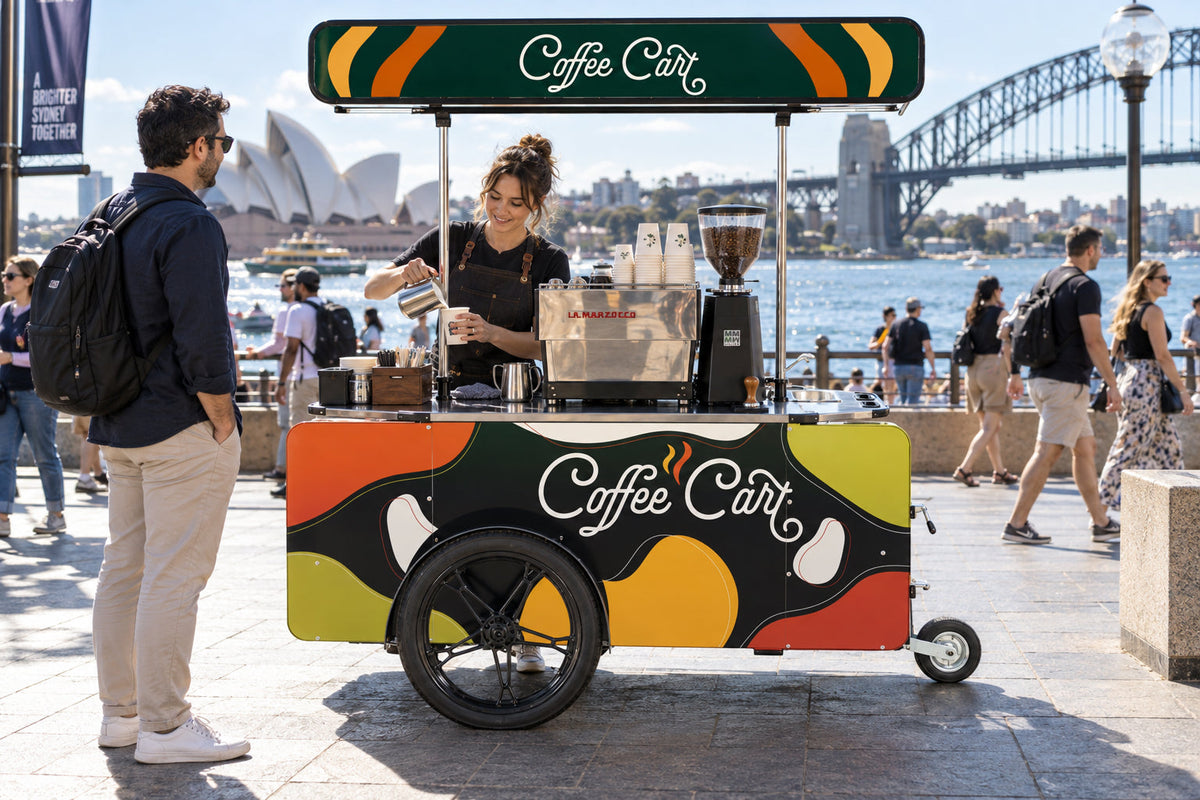
With this in mind, BizzOnWheels offers two main platforms: Coffee Cart L and Coffee Cart M. Both have a strong metal frame, durable cladding, stainless-steel worktops, and can be used as push carts or towed behind an e-bike. However, they meet different needs. Coffee Cart L is the flagship model. It’s a large mobile coffee kiosk that can hold a one- or two-group espresso machine, grinders, a fridge, water tanks, and supplies for busy days. It is about 2.2 metres long, nearly a metre deep, and weighs around 125 kilograms empty, built to carry up to 300 kilograms when loaded. Inside, it has an electrical system for 220–110V, a built-in sink with cold water, spacious cabinets, and two outside storage bays for heavy items like water or fridges, all without losing balance.

One standout feature of Coffee Cart L is its roof, which provides shelter and is ready for solar panels. As energy prices change and brands focus on sustainability, more operators are considering solar options for their mobile coffee setups. Market data shows that portable and off-grid coffee equipment is growing quickly, with portable coffee maker sales expected to reach $8.6 billion by 2030.
It’s important to be realistic: even efficient solar panels in the 140–200W range can’t power a 3,000-watt espresso machine by themselves. However, they can help run pumps, controls, LED lights, and electronics, reducing the load on batteries or generators and giving your brand a real sustainability story. For many, this mix of professional equipment and renewable support Coffee Cart L is best for operators who already know they have steady demand. For example, a café adding a mobile unit for festivals or corporate events needs a setup that feels familiar to staff, has enough space for a bigger menu, and can handle long lines. Brands that use coffee for experiential marketing also prefer the larger cart, since it offers four large branding areas, tall spaces for graphics, and enough weight to stay put at busy events. For these brands, the cart is more like a temporary flagship store than just a concession stand.sion stand.

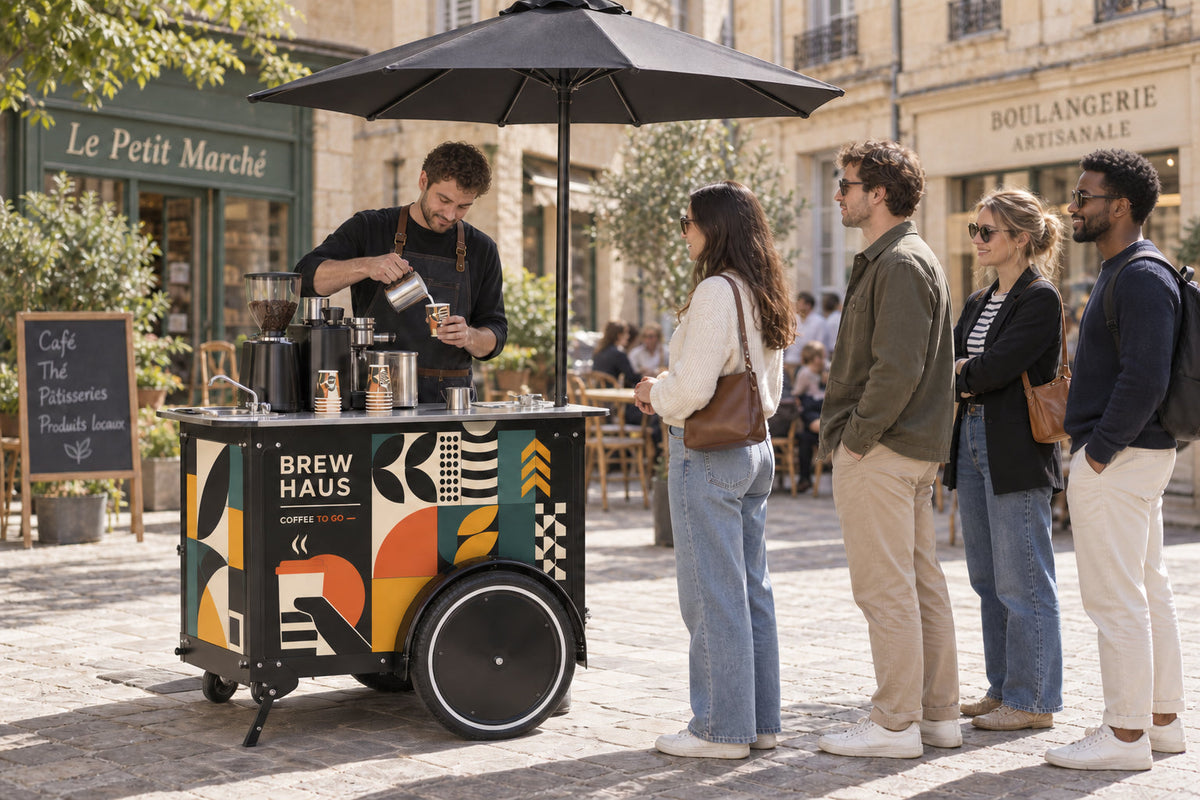
Coffee Cart M is a more compact choice. It measures about one metre by 0.8 metres, taking up about half the space of the larger model and weighing around 65 kilograms empty, with a maximum load of 120 kilograms. The smaller stainless worktop fits a single-group or semi-professional machine, a grinder, and a few accessories. Storage is limited and mostly inside, so operators usually use it for shorter shifts and smaller inventories. Instead of a heavy roof, it uses an umbrella or light shade, which keeps it stable and easy to move. In tight spaces like indoor corridors, elevators, or small lobbies, this flexibility is more useful than extra storage.

This smaller cart is popular with first-time founders and those testing new markets. If your main goal is to see if commuters will pay €3.80 for a flat white outside a station, or if a corporate campus will support daily service, it makes sense to start small. A compact cart lets you work part-time, move locations as you learn, and keep costs low. If your idea works, you can add another Coffee Cart M or upgrade to Coffee Cart L when you have a steady spot that needs more storage and branding. This step-by-step approach is common in mobile retail and pop-up businesses, from fashion kiosks to food trucks.

Coffee Cart M is also great for founders who need to move often. These operators might work at underground stations, office buildings, and evening events, often using public lifts and entrances not designed for large kiosks. For them, every extra kilogram or centimetre can make access harder or even impossible. A slim coffee bike or cart that can be towed by an e-cargo bike, parked indoors, and moved by one person is much more practical than a mobile unit that rarely moves.
Despite their differences, both carts have the same daily needs: power, water, and hygiene. New entrepreneurs sometimes only think about these issues for each event, but they are ongoing concerns. If you usually have a fixed power source, like in malls or office buildings, both carts work well. If you plan to operate in plazas, parks, or streets with limited power, Coffee Cart L’s space for batteries, inverters, and gas, plus its solar-ready roof, gives you more options. Local rules also matter. Many cities require sinks, running water, and enclosed wastewater tanks for mobile vendors, and some have strict standards for worktop and wall materials. Information Commissioner's Office+1 Building these features into your cart from the start makes inspections easier and staff training simpler.
It’s easy to forget that these choices also affect your brand. Today’s consumers are careful with spending but will pay more for something unique, convenient, and that matches their values. McKinsey’s latest research shows that even with rising prices, people still spend more on experiences and products that make them happy or save time, while cutting back on basic items.
A well-designed coffee pop-up or kiosk that appears where people are—like outside a co-working space or in a park meets both needs. It offers a pleasant break and saves time, while the mobile setup shows your business is modern and flexible. When you add strong branding and good service, your cart becomes a marketing tool that does more than a regular billboard ever could.
Prospective operators often have practical questions. Both Coffee Cart L and Coffee Cart M can be used indoors, as long as you follow rules on ventilation, power, and avoid gas equipment where it’s not allowed. Solar power alone can’t run a professional espresso machine, but it can help with other electrical needs and support your sustainability message when used in a hybrid system. Most places require you to get a trading license, pass health checks, and follow zoning rules, whether you have one cart or several. Choosing a cart from a manufacturer with experience in mobile business, like those who make bicycle billboards and branded trailers, gives you a head start in meeting these requirements.As the coffee industry shifts from fixed locations to mobile formats, successful entrepreneurs will see their cart as both a business tool and a way to share their brand’s story. The real question isn’t just “Coffee Cart L or Coffee Cart M?” but “What kind of business do I want, and which platform will help me get there?” For some, that means a large, high-capacity kiosk with a solar-ready roof. For others, it means a fleet of agile coffee carts moving through the city. Either way, this choice deserves careful thought, because in the world of mobile cafés, your cart may be your most valuable real estate.