Article: The Coffee Cart As Strategy: How Bizz On Wheels Turns A Metal Box On Wheels Into A Mobile Business Platform
The Coffee Cart As Strategy: How Bizz On Wheels Turns A Metal Box On Wheels Into A Mobile Business Platform
Choosing a coffee cart is not a design decision. It is a strategic bet on how, where, and how fast your brand will grow. In a world where the global coffee shop market is already worth more than $220 billion and still expanding at roughly 4–5% annually, operators are under pressure to find formats that are lighter on capex and faster to deploy than traditional bricks-and-mortar cafés.Street food and mobile foodservice have moved from the margins to the mainstream; food trucks and carts are now part of the urban fabric, with Europe’s food truck segment alone forecast to grow at more than 7% a year toward 2030. Against this backdrop, the humble coffee cart or its close cousins, the coffee bike, coffee stand, coffee kiosk and coffee pop up has become a serious business platform. For Bizz On Wheels, that platform is engineered, quite literally, on wheels.

Analysts now estimate the global coffee cart market at around $4.22 billion in 2025, with projections that it could approach $7.9 billion by 2033, a compound annual growth rate of roughly 7.2%. That growth is not driven by nostalgia for quirky carts; it is powered by operators who understand that the cart is their operating system. The dimensions of the cart dictate how many drinks you can push through a morning rush. Its footprint determines which licenses you can obtain, from indoor lobbies and corporate campuses to crowded promenades and festival grounds. Its engineering shapes your fixed costs: water autonomy, power mix, cold storage and durability all feed into your margins. In other words, before you design a logo or an Instagram grid, you are choosing an industrial platform that must behave like a café in miniature.
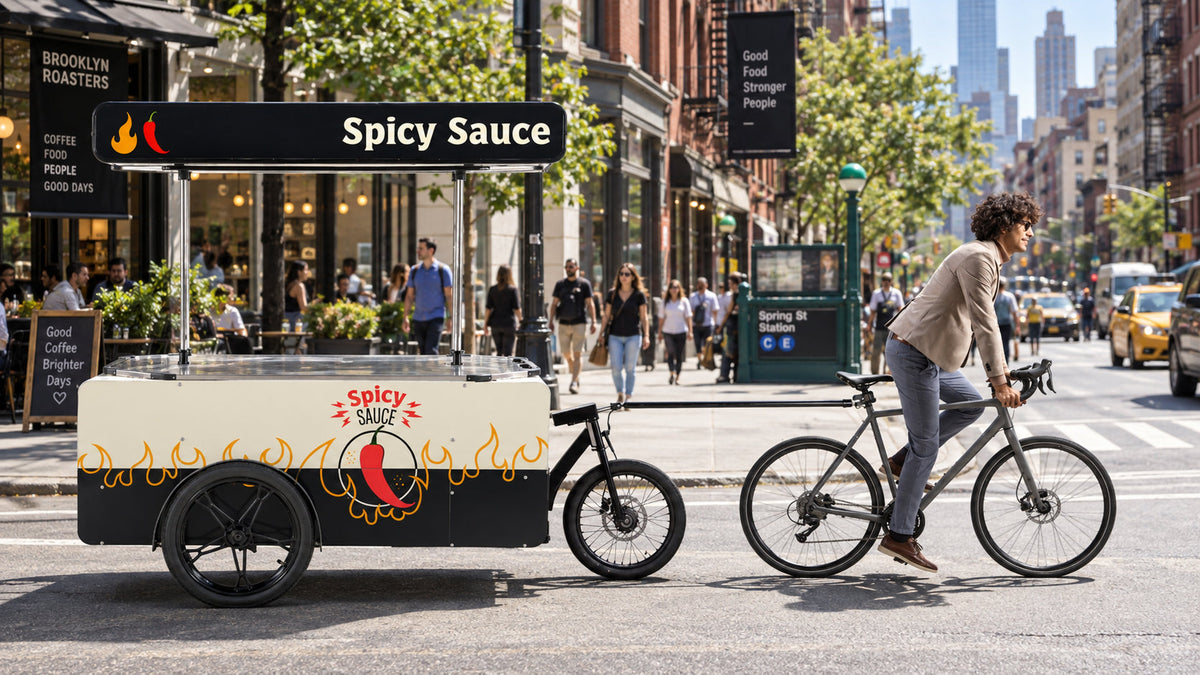
For Bizz On Wheels, that platform comes in a deliberately focused range. Rather than diluting the lineup with fixed coffee kiosks, improvised coffee stands or fully integrated coffee bikes, the company concentrates on professional coffee carts and towable coffee cart trailers in two footprints size L and size M. These carts can act as stand-alone mobile cafés or transform into coffee bike trailers hitched to a standard bicycle or e-bike. The decision to standardize on robust, towable carts is not cosmetic. It reflects a shift in mobile retail toward modular systems that can live different lives during the same trading day: static in the morning outside a metro station, bike-towed in the afternoon through a park, redeployed as a branded coffee pop up at an evening event.

To play in that league, a coffee cart has to stop behaving like a prop. It has to behave like infrastructure. That begins with the coffee engine itself. Serious mobile operators increasingly rely on dual-fuel espresso machines – systems that can run on LPG or butane in off-grid locations and switch to electricity when shore power is available. Manufacturers such as Fracino have built entire product lines around this requirement; their dual-fuel Contempo and Retro machines are explicitly designed for mobile operators, combining LPG with 12V battery systems to deliver the same output you would expect from a static bar. On a Bizz On Wheels cart, that kind of machine, paired with a commercial burr grinder built for continuous use, turns a pretty frame into a serious production unit capable of sustaining high-volume trading, not just occasional lattes.
Beyond extraction, the real test of a “business-ready” coffee cart is its autonomy. Health regulations in European cities and beyond increasingly require running water, hand-washing facilities and hygienic separation of fresh and waste water – requirements that grew more stringent in the wake of the pandemic and are now standard in food-service licensing. A professional cart therefore needs a closed-loop water system with one or more stainless-steel sinks, a pump, a 12V battery, and properly sized freshwater and greywater tanks. Bizz On Wheels treats this as non-negotiable infrastructure, designing automated water systems into both L and M carts and adjusting the number of sinks, materials and electrical standards to the operator’s local code. For operators, this engineering discipline means one less regulatory headache and one more reason inspectors treat the cart as a legitimate, compliant micro-café rather than a hobby project.

Cold storage and power management quietly separate amateur builds from scalable platforms. In climates where dairy and alternative milks must be held within strict temperature bands, relying on coolers packed with ice quickly becomes unsustainable. This is why more than 60% of coffee cart operators are now shifting to eco-friendly solutions, including solar-assisted power and efficient refrigeration On Bizz On Wheels units, the architecture anticipates this shift: the carts are pre-engineered to accept cold boxes or 12V mini-fridges, LPG tanks, and optional solar panel and battery kits. The result is a quiet but crucial advantage: the barista can keep milk, syrups and perishables in a safe temperature range for a full trading day, whether the cart is operating as a static coffee stand in a business park or a roaming coffee bike on the waterfront.
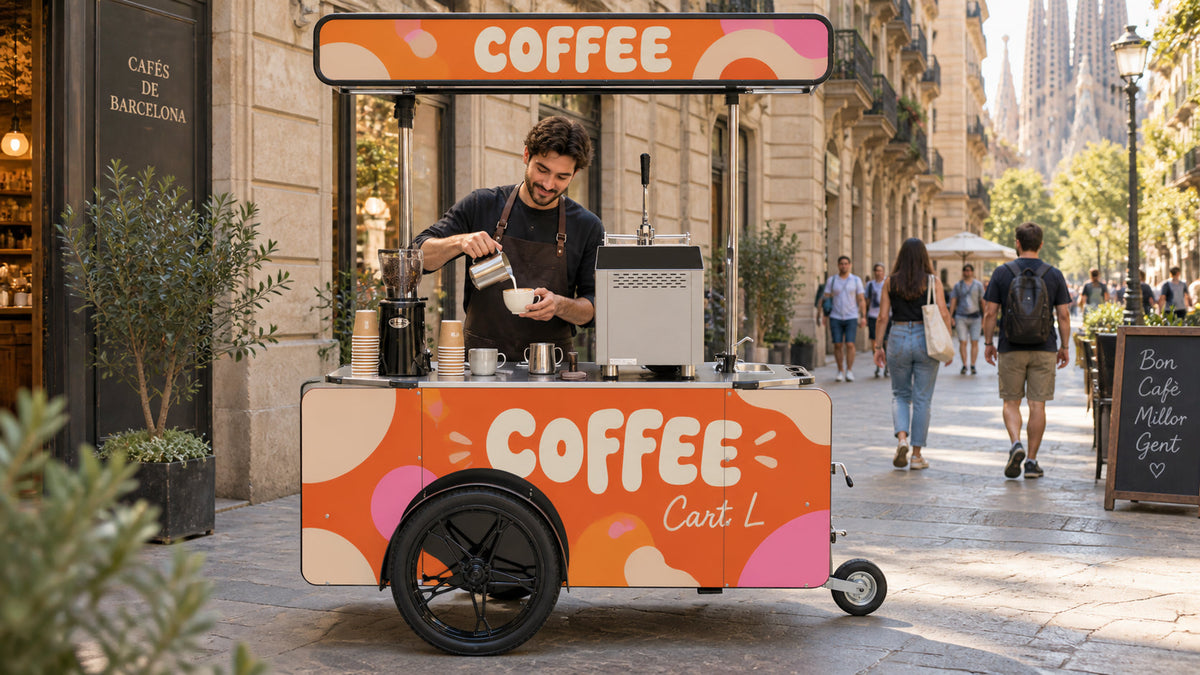
Within that technical backbone, the Bizz On Wheels range splits into two footprints. The L-size coffee cart is the flag-ship a full-scale mobile café on wheels, designed to handle the kind of peak rushes traditionally associated with high-street chains. Sized to accommodate a dual-fuel one- or two-group espresso machine, grinder, LPG tank, cold storage and comprehensive water system, it offers a food-grade stainless-steel worktop, integrated knockbox, generous interior and exterior storage, and a folding roof with side panels that double as weather protection and branding real estate. The Basic Coffee Cart L configuration focuses on infrastructure first: it ships with the structural and hygienic essentials, leaving space for operators from specialty cafés to coffee roasters and equipment manufacturers to integrate their own machines, grinders and accessories. That makes it a natural fit for brands that already know their preferred gear and want the cart as a neutral, robust chassis.

For entrepreneurs who value speed to market over specifying every bolt, the Premium Coffee Cart L plays a different role. It takes the same L size chassis and delivers a turnkey, ready-to-trade coffee kiosk on day one. A dual-fuel Fracino machine, a matched grinder, folding countertop extensions and a solar-ready electrical kit are installed, wired and tested in advance, transforming the cart into a plug-and-pour operation. For first time mobile coffee entrepreneurs, large employers rolling out branded coffee concepts across campuses, or hospitality groups piloting a mobile format without committing to a full store build, the Premium L is essentially a “coffee shop in a crate.” From an investor’s perspective, that level of integration compresses the time between capital outlay and the first paid espresso, the moment when a cart stops being a cost centre and becomes a revenue generating asset.
If the L size carts are built for throughput, the Coffee Cart M is built for agility. This smaller footprint is a compact mini-café, light enough to manoeuvre into tight indoor corners, boutique hotel lobbies, small plazas or trade-show aisles where full-size units simply do not fit. It retains the essentials a stainless counter, knockbox, automated water kit, internal storage and a generously sized umbrella for shelter and branding – yet its scale naturally steers it toward use cases where presence matters as much as volume. Brands use M-size carts as tasting bars for product launches, as mobile sampling units at festivals, or as premium coffee pop ups in high-traffic atriums where a permanent build-out would be overkill. In those environments, the cart is both utility and billboard.

What sets Bizz On Wheels apart in a crowded mobile coffee landscape is its decision to decouple the cart from the drivetrain. Rather than hard-wiring equipment into dedicated “coffee bikes,” the company builds carts that can convert into coffee bike trailers via a universal saddle hitch. This mirrors a broader shift in micro-retail design, where modularity and reconfiguration are privileged over single-use formats. Case studies of bike-based food carts, from the Wheelys Café model to European coffee bikes, show that pedal-powered units can operate as fully equipped cafés with smaller ecological footprints and strong visual appeal. By making the towing option an add-on rather than a baked-in constraint, Bizz On Wheels lets operators choose: tow an L or M cart behind a bike or e-bike along urban routes in the morning, then unhook and trade as a static unit at a lunchtime hotspot or evening concert, without needing a van or towing vehicle.
Choosing between an L or M cart, and between static or trailer configuration, ultimately comes down to business model rather than aesthetics. Established cafés, roasteries and coffee brands tend to treat the cart as an extension of an existing ecosystem. Their question is not “Can this make coffee?” but “What job should this platform do for my brand?” For an operator looking to push beyond the front door – into festivals, corporate events or semi-permanent outdoor pitches a Basic Coffee Cart L provides the infrastructure to plug in their preferred dual-fuel machine and grinder, aligning mobile quality with in-store standards. Where the brief is more about experience and sampling for example, a roaster showcasing a new origin or capsule range the Coffee Cart M’s smaller footprint often proves more adaptable.
First time mobile coffee entrepreneurs, by contrast, face a different calculus. They are buying not just steel and hydraulics, but confidence: the belief that the cart will allow them to execute a viable business model. Recent analysis of specialty coffee cart businesses highlights the importance of gross margin, net margin and average transaction value as core KPIs.
For founders who want to move from idea to operating reality as quickly as possible, the Premium Coffee Cart L reduces integration risk. It is engineered to behave like a small café from day one, capable of handling real commuter rushes at transport hubs, campuses or busy plazas. Entrepreneurs targeting lighter, more nomadic trade – farmers’ markets, community events, creative districts – often gravitate toward an M-size cart configured as a coffee bike trailer, trading some capacity for unparalleled mobility and lower towing effort.
Corporate clients, hospitality groups and agencies think in fleets rather than single units. In this segment, L-size carts often become semi-permanent installations: a cluster of mobile cafés in a business park, the anchor of an outdoor food court, or a branded coffee kiosk at the entrance to a stadium. In parallel, M-size carts function as roaming assets, dispatched to lobbies, conference rooms, boutique events or outdoor activations where a full-size cart would be impractical. The bike-trailer capability adds another layer, allowing brands to move units between event zones without heavy logistics – a growing consideration as European cities tighten vehicle access to central districts and event organizers increasingly favour low-emission vendors.
Behind all these choices lies a broader structural shift in how coffee is consumed. Street food already accounts for a significant share of global food-service transactions – estimates from the early 2010s suggested that as many as 2.5 billion people eat street food daily – and rising interest in specialty coffee, ethical sourcing and local experiences has only deepened demand for high-quality products served in unconventional formats.
With high-street chains facing cost pressures and increasingly saturated locations, agile micro-operators are stepping into the gaps, using formats like coffee carts and coffee bikes to trade in places where a full lease would never pencil out. In that environment, the Bizz On Wheels philosophy is disarmingly simple: build carts that behave like serious cafés, then give operators the choice to push them, tow them, or anchor them wherever the opportunity is greatest.

For anyone planning to put a coffee brand on the move – whether as a stand-alone mobile venture or as an extension of an existing café – the cart is the first real strategic decision. The right configuration balances capacity with manoeuvrability, autonomy with compliance, and capital cost with lifetime durability. Bizz On Wheels’ L and M coffee carts, with their dual identities as stand-alone units and coffee bike trailers, are designed to sit at the centre of that equation. The logical next step is a conversation: share your city, your concept and your expected trading patterns, and the team can help architect a cart or coffee bike trailer setup that is not just beautiful, but engineered to be the backbone of a modern mobile coffee business.
References
Source 1 – Global coffee cart market size and growth:
https://www.proficientmarketinsights.com/market-reports/coffee-cart-market-3057
Source 2 – Global coffee shop market size and forecast:
https://www.jadhavarbusinessintelligence.com/market-research-report/coffee-shops-market/1010
Source 3 – Europe food truck market outlook and growth:
https://www.researchandmarkets.com/report/europe-food-truck-market
Source 4 – Global food trucks market analysis:
https://www.technavio.com/report/food-trucks-market-analysis
Source 5 – Dual-fuel espresso machines for mobile operators (Fracino):
https://www.fracino.com/dualfuel.html
Source 6 – Additional technical details on Fracino LPG dual-fuel machines:
https://www.indigovalley.co.uk/traditional-coffee-machines/2577-fracino-lpg-dual-fuel-contempo.html
Source 7 – Coffee bike / bike coffee cart concept and setup guidance:
https://espressoacademy.it/en/guide-en/a-step-by-step-guide-on-how-to-open-a-coffee-bike-cart/
Source 8 – Case studies of bicycle food cart designs (including portable coffee concepts):
https://www.motrike.com/bike-food-cart-design/
Source 9 – Coffee-Bike mobile café concept:
https://coffee-bike.com/en/our-products/the-coffee-bike/
Source 10 – KPIs for specialty coffee cart businesses:
https://startupfinancialprojection.com/blogs/kpis/specialty-coffee-cart
Source 11 – Street food culture and consumption statistics:
https://www.researchgate.net/publication/344087195_The_Street_Food_Culture_in_Europe
Source 12 – Coffee market forecast (Statista summary):
https://www.scribd.com/document/739837452/Coffee-Worldwide-Statista-Market-Forecast