Why Mobile Advertising Bike Billboards Outperform Static Billboards
Walk through any major city and the story is the same: a skyline crowded with static billboards, layered above ring roads and expressways like advertising sediment. The numbers behind that backdrop are formidable. Outdoor advertising is a roughly $16 billion global market today and projected to surpass $26 billion over the next decade, even as brands divert more money into digital channels. Yet talk to planners inside leading agencies and a paradox emerges. Out-of-home (OOH) is one of the most trusted, high-recall media formats on the plan, but the classic static billboard is often the least interesting way to buy it. In an era of scrolling, swiping and skipping, the billboard that never moves is flirting with irrelevance.

Part of the problem is cognitive, not creative. We have spent twenty years training ourselves to ignore anything that looks like an ad, a phenomenon researchers call “banner blindness.” Studies show that as many as 86% of users simply tune out banner-style formats online often failing to see them at all, even when they sit in the direct line of sight. The same psychology applies on the street. When a city corridor is lined with near-identical 48-sheet billboards, most commuters’ brains file them away as background noise. Digital roadside screens do perform better recent research suggests they grab more than twice the attention of static boards but that improvement is still constrained by a deeper structural flaw: they are tied to one fixed point on the map. In a world where people and commerce are constantly in motion, a message nailed to a wall is easy to overlook.

Regulation compounds the issue. Traditional billboards are subject to strict zoning and permitting regimes that confine them to specific commercial and industrial corridors, often prioritising driver safety over pedestrian engagement. Local authorities restrict size, height, spacing and placement near intersections or crossings, which is sensible public policy but inflexible marketing infrastructure. The result is that many of the most advertising-saturated locations are precisely those where consumers are least receptive: fast moving traffic lanes where dwell time is measured in seconds and attention is fixed on the road. Studies still show strong recall for outdoor advertising in general, but those gains increasingly come from formats and placements that break away from the standard roadside rectangle.
This is where mobile billboards begin to outperform their static cousins and where bike-based formats such as AdBikes, promobike fleets and branded adbicy trailers start to look less like novelty and more like strategy. Mobile billboard trucks already demonstrate the basic principle: when the media space moves with people, engagement climbs. Industry data suggests mobile billboards can generate around 45% more engagement than static billboards or print, with some studies claiming that 90–95% of people notice ads on a mobile unit, compared with far lower “real” attention rates for fixed roadside boards. Case studies from cities like Nashville and New York show brands using mobile billboard trucks to orbit festivals, sports fixtures and nightlife areas, effectively chasing demand rather than waiting for it to pass. What happens when you shrink that proposition from a truck to a bicycle is that the medium becomes not only more flexible, but more human.

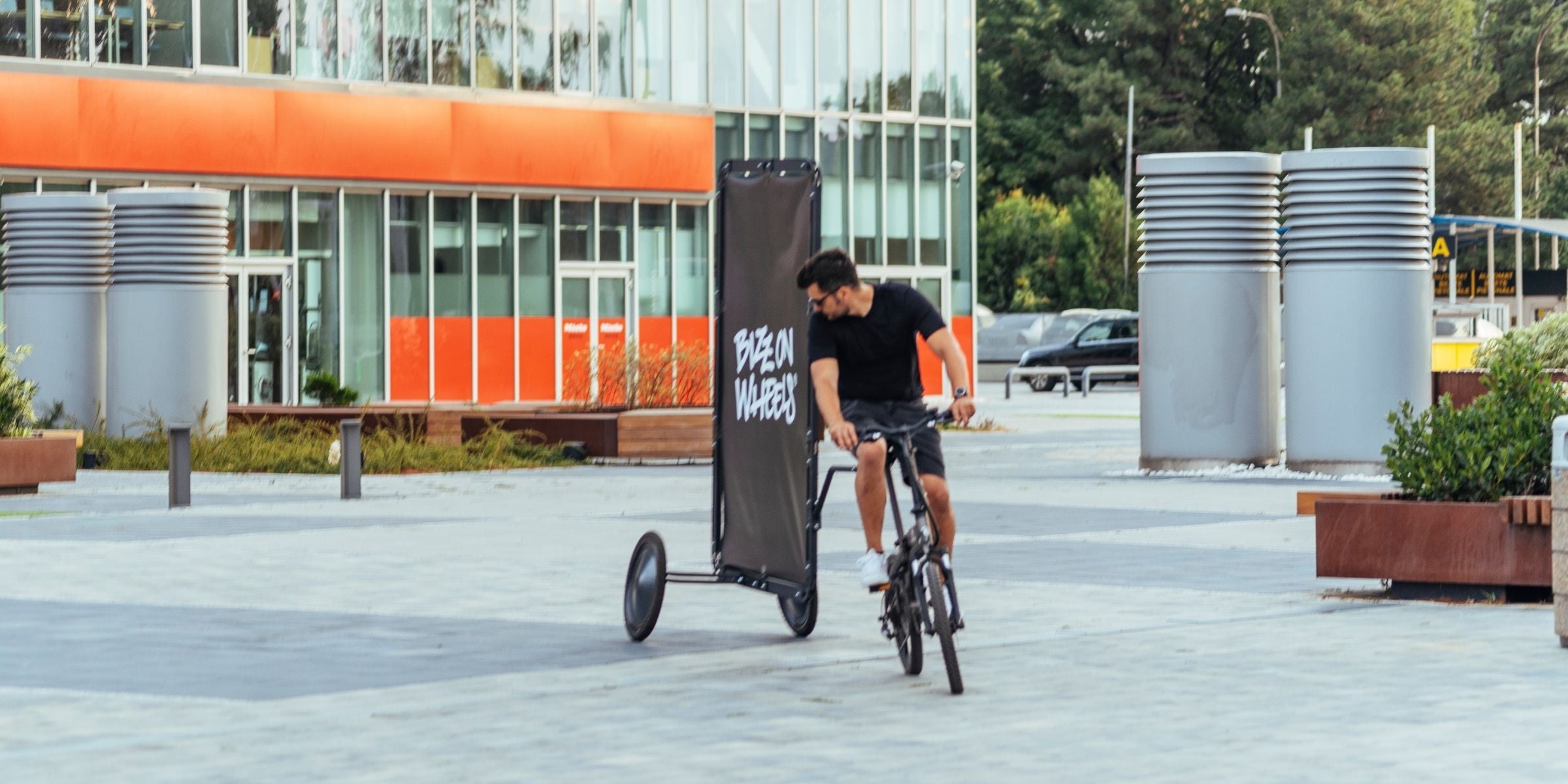
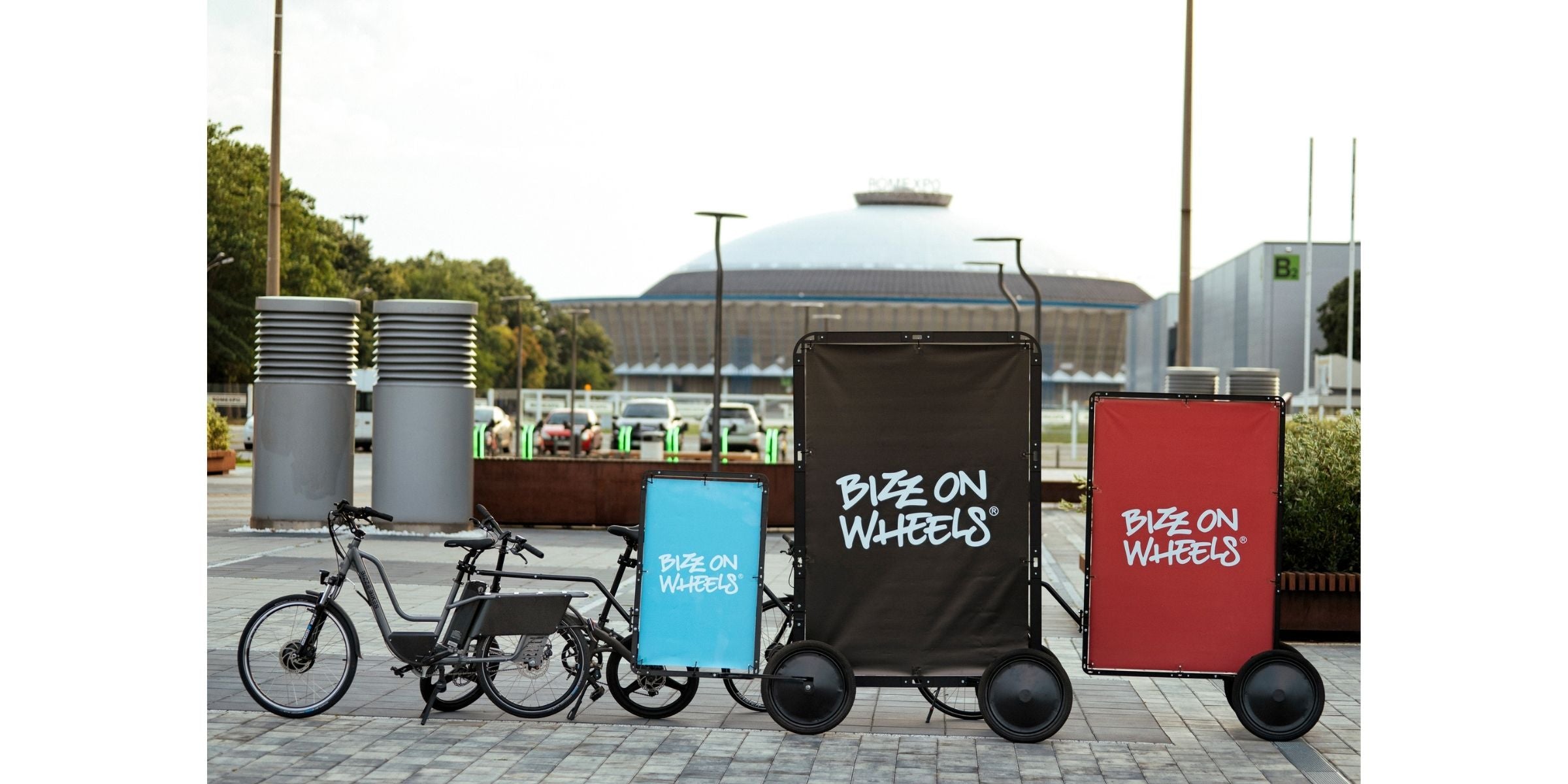
Unlike trucks, advertising bike billboards operate at walking speed and at eye level, threading themselves directly into the natural flow of pedestrians. Providers from London to Berlin now treat adbikes as a mainstream urban format, deploying double-sided panels equivalent in size to a bus shelter poster but mounted on a lightweight trailer behind a rider. When those panels move slowly through a shopping street, plaza or waterfront, they trigger a different kind of attention. People look up not because the creative is louder, but because the medium itself is unexpected: a mobile billboard in a familiar environment. One UK operator notes that these campaigns are particularly effective in town centres and pedestrianised zones that are off-limits to larger vehicles a natural domain for AdBikes and promobike campaigns.
Access to those pedestrian-only environments is not a trivial advantage; it is the heart of the value proposition. Zoning laws that constrain roadside billboards often leave historic centres, promenades, university campuses and event venues largely untouched by large-format advertising. Yet these are precisely the places where people are moving slowly, open to discovery and often in a “treat yourself” mindset. Retailers and FMCG brands have begun to notice. In Germany, for example, Aldi’s “Good for everyone” campaign used more than 5,600 branded bicycles across eight major cities as both mobile media and a symbol of sustainable mobility, weaving the brand into the everyday fabric of urban life rather than shouting at it from a gantry above a ring road. This is not just reach; it is high-intent reach in contexts where people are primed to browse, sample and share.
The operational model behind bike billboards is equally disruptive. Traditional static campaigns lock brands into long booking periods, high production costs and lead times measured in weeks or months. By contrast, a modern AdBike or adbicy trailer is deliberately designed as a reusable asset: modular frames, standardised print panels and structures light enough for any competent cyclist to tow, with no special licence required. Operators can load several units into a single van, reposition them to a different district between morning and evening, and rotate the creative on a weekly basis. Mobile billboard providers routinely present this flexibility as a cost-efficiency play, arguing that they can deliver Times Square level visibility at a fraction of the price by taking the campaign to high-traffic neighbourhoods instead of renting fixed premium locations. For brands working with tight budgets, that agility makes short, tactical activations not only possible but financially attractive.
Perhaps the most powerful advantage of bike billboards, however, is that they blur the line between media and experiential marketing. The last few years have cemented what many CMOs already suspected: live experiences move the needle. Surveys consistently show that around 85% of consumers are more likely to purchase after participating in a branded event, and roughly 77–90% of marketers say that experiential campaigns are their most effective channel for engagement and sales. Agencies are increasingly measuring “engaged minutes” the time a person actively interacts with a brand as a core KPI for these campaigns. A promobike team handing out samples, scanning QR codes and chatting with passers-by in a plaza can easily rack up thousands of engaged minutes in a single afternoon, all while the bike’s banner quietly reinforces the core message. The medium becomes a rolling micro-event rather than a passive surface.
This human-scale presence matters at a time when consumers are both sceptical of advertising and hungry for authenticity. Research on sustainability and green marketing shows that most consumers are now aware of eco-friendly products and are often willing to pay a premium for them PwC’s 2024 global survey found an average willingness to spend nearly 10% more for sustainable goods, while other studies note broad recognition of the social and environmental benefits of “green” offerings. At the same time, regulators are cracking down on vague environmental claims; in the UK, for example, the Advertising Standards Authority has recently banned several high-profile fashion campaigns for “greenwashing” when their sustainability messaging could not be substantiated. Against that backdrop, an emissions-free or low-emission AdBike campaign reads as a tangible expression of a brand’s values, not just a line in a CSR report. When your message arrives on a bicycle or e-bike instead of a diesel van, the medium itself becomes part of the story.
Zoom out to the macro level and the strategic logic becomes even clearer. Digital out-of-home is one of the fastest-growing slices of the media pie; analysts estimate that digital formats will account for more than 40% of total OOH revenue this year, with the DOOH market projected to grow from roughly $15–20 billion today to more than $40 billion within a decade. Telecoms and tech players are taking notice: T-Mobile’s planned $600 million acquisition of Vistar Media, a programmatic DOOH platform, is a clear bet that location-based, real-world media will play a central role in the next wave of advertising. While AdBikes and promobike campaigns are often analogue rather than digital, they plug neatly into this shift. Routes can be planned around first-party data, activations can be time-synced with mobile push notifications or social content, and the units themselves can be equipped with GPS or even small digital screens. In other words, bike billboards behave like a physical extension of a brand’s geo-targeted digital strategy, not an isolated stunt.
For B2C brands, especially those targeting urban Millennials and Gen Z, this mix of movement, sustainability and proximity is potent. Deloitte’s longitudinal research on sustainable consumers shows that more than 70% of people still say environmental issues are as important or more important than a year ago, even under inflationary pressure, and other studies link eco-friendly choices to higher repeat purchase rates and brand loyalty. Bike-based mobile billboards embody that ethos: they reduce reliance on high-emission vehicles, reclaim city space for human-scale experiences and signal a certain cultural fluency. A cool, well-designed adbicy unit outside a music festival or tech conference does more than deliver impressions; it telegraphs that the brand understands the rhythm of the city.

Static billboards are not going away. They still have a role in building broad awareness and anchoring large integrated campaigns. But the brands that want to be not just seen, but remembered—and talked about—are increasingly stepping off the skyline and into the street. Mobile advertising bike billboards turn the city itself into a media plan: mornings near transit hubs, lunchtime around office districts, afternoons in shopping streets, evenings at concerts or sports arenas. They offer the kind of flexible, sustainable, human-centred storytelling that static structures simply cannot match. For ambitious marketers with finite budgets, that combination is less a tactical option and more a competitive advantage on two wheels.
References
https://finance.yahoo.com/news/outdoor-advertising-market-reach-26-141600107.html
https://neilpatel.com/blog/banner-blindness/
https://wpadvancedads.com/banner-blindness/
https://forty7.media/blog/are-digital-billboards-more-effective-than-static-billboards/
https://abcsinsights.com/wp-content/uploads/2025/08/OOH-Advertising-Quantified-Report.pdf
https://oaaa.org/news/new-study-finds-digital-out-of-home-advertising-surpasses-other-media-in-driving-favorability-and-action-among-consumers/
https://oaaa.org/wp-content/uploads/2022/09/A-to-Z_Rebranded2018.pdf
https://75media.co.uk/blog/roadside-advertising-regulations/
https://www.advision.digital/2024/11/30/11-factors-outdoor-advertising/
https://oneday.agency/blog/5-stats-about-out-of-home-advertising
https://momentara.com/news-insights/ad-trucks-vs-traditional-advertising-which-delivers-better-results/
https://directadphilly.com/how-mobile-billboards-drive-local-success-for-small-businesses/
https://movingmedia.com.au/who-benefits-most-from-digital-vs-traditional-mobile-billboards/
https://vigyapanmart.com/blogs/mobile-billboard-compare-to-static-billboards-in-terms-of-effectiveness
https://cantmiss.us/blogs/mobile-billboard-truck-is-it-worth-it/
https://imagebrandnashville.com/blog/case-study--successful-billboard-truck-campaigns-in-nashville
https://bizzonwheels.com/pt/advertising-bike-billboards-are-more-effective-than-static-ones/
https://penji.co/ads-on-bikes/
https://www.mobilebillboards.co.uk/digital-ad-bikes/
https://www.mobile-billboards.co.uk/project/adbikes/
https://www.trendkost-promo.de/en/bike-advertising/
https://promobike.uk/
https://www.nextbike-media.com/en/bicycle-advertising-as-part-of-the-360-degree-campaign-good-for-everyone/
https://www.limelightplatform.com/blog/experiential-marketing-statistics
https://www.teamtecna.com/news-and-resources/experiential-marketing-statistics/
https://products.seeker.io/blog/18-stats-about-experiential-marketing-in-2024/
https://learn.g2.com/experiential-marketing-statistics
https://imagination.com/latest/how-to-measure-the-success-of-experiential-marketing-campaigns/
https://www.pwc.com/gx/en/news-room/press-releases/2024/pwc-2024-voice-of-consumer-survey.html
https://www.researchgate.net/publication/386292656_Consumer_Attitudes_toward_Green_Marketing_and_Eco-Friendly_Products_An_Analysis_of_Awareness_and_Satisfaction_in_the_Rohilkhand_Region
https://www.simon-kucher.com/en/insights/sustainabilitys-new-normal-what-2024-consumers-expect
https://www.deloitte.com/uk/en/Industries/consumer/perspectives/the-sustainable-consumer.html
https://plasticbank.com/blog/how-consumer-demand-is-fueling-the-sustainability-shift/
https://www.mckinsey.com/industries/consumer-packaged-goods/our-insights/consumers-care-about-sustainability-and-back-it-up-with-their-wallets
https://yougov.com/en-gb/articles/49572-british-attitudes-towards-sustainability-on-world-environment-day-2024
https://www.ft.com/content/420775aa-dbce-42a5-958b-4df2fc7036fc
https://www.marketgrowthreports.com/market-reports/digital-ooh-advertising-market-114278
https://www.fortunebusinessinsights.com/digital-out-of-home-advertising-market-113720
https://www.mordorintelligence.com/industry-reports/digital-ooh-market
https://oaaa.org/news/new-study-finds-digital-out-of-home-advertising-surpasses-other-media-in-driving-favorability-and-action-among-consumers/
https://investor.clearchannel.com/news/detail/538/new-kantar-study-shows-out-of-home-advertising-outperforms-key-channels-and-addresses-gaps-in-modern-marketing-strategies
https://www.reuters.com/markets/deals/t-mobile-acquire-vistar-media-600-million-bolster-advertising-business-2025-01-13/
https://www.axios.com/2025/01/13/t-mobile-vista-media-advertising