The Street Food Playbook: The Best Guides, Tools And Communities For Building A Food Cart Business That Actually Lasts
Almost every future street food founder knows the feeling: it’s late at night, and you have a dozen tabs open. One is about food hygiene rules, another covers hot dog carts, there’s a Reddit thread on generators, and maybe a TikTok of a busy food truck festival. The opportunity is obvious, but the next steps are not. The global food truck and food cart market is now worth billions and is growing by about 6 to 7 percent each year, driven by people looking for quick meals with a unique experience and a sense of place. But the information you need to turn an idea into a real business is scattered and often unreliable.
The 2026 BizzOnWheels Street Food & Food Cart Business Resources guide is here to help. Rather than telling you what to cook or which logo to choose, it gathers the best how to guides, legal resources, business plan templates, communities, podcasts, and tools that real operators rely on. Our team builds custom food carts, coffee carts, and food bikes for founders across Europe and beyond, so we see firsthand what works and what doesn’t.
BizzOnWheels in house guides are central to this library for a reason: most mainstream advice treats mobile food as if it’s just a small restaurant on wheels. But food carts have their own business models and rules. Our guides take a different approach. “How to Start a Food Cart Business: A Step-by-Step Guide” helps beginners understand the basics concept, menu, costs, and what it’s really like to run a mobile business before they start thinking about menu boards. “Street Food 2026: The Complete Guide to Launching and Scaling with Food Bikes & Food Carts” goes even further, comparing carts and food bikes and showing how small, eco-friendly units can be used as flexible building blocks for growth.
Along with the main guides, we offer niche resources that answer the real questions people ask us. The hot dog cart guide is popular because hot dogs are a great way to learn: they’re easy to prepare, quick to serve, and have good profit margins. Toast’s 2025 “How To Start A Hot Dog Cart Business” notes that well run stands can use low start up costs and portable setups to try different locations, as long as operators handle licensing and food safety from the start. Our own hot dog cart content adds to this by showing how cart layout and workflow can boost sales, such as using toppings bars or combo deals, while still meeting the standards of local inspectors who see many makeshift setups each summer.
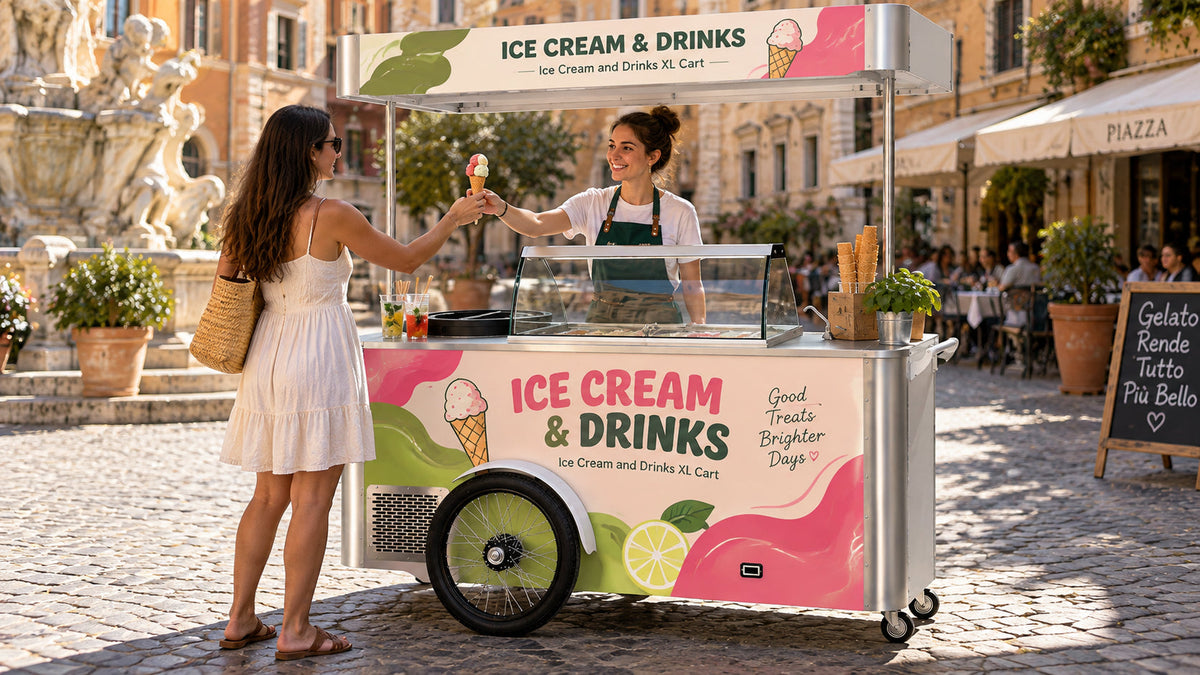
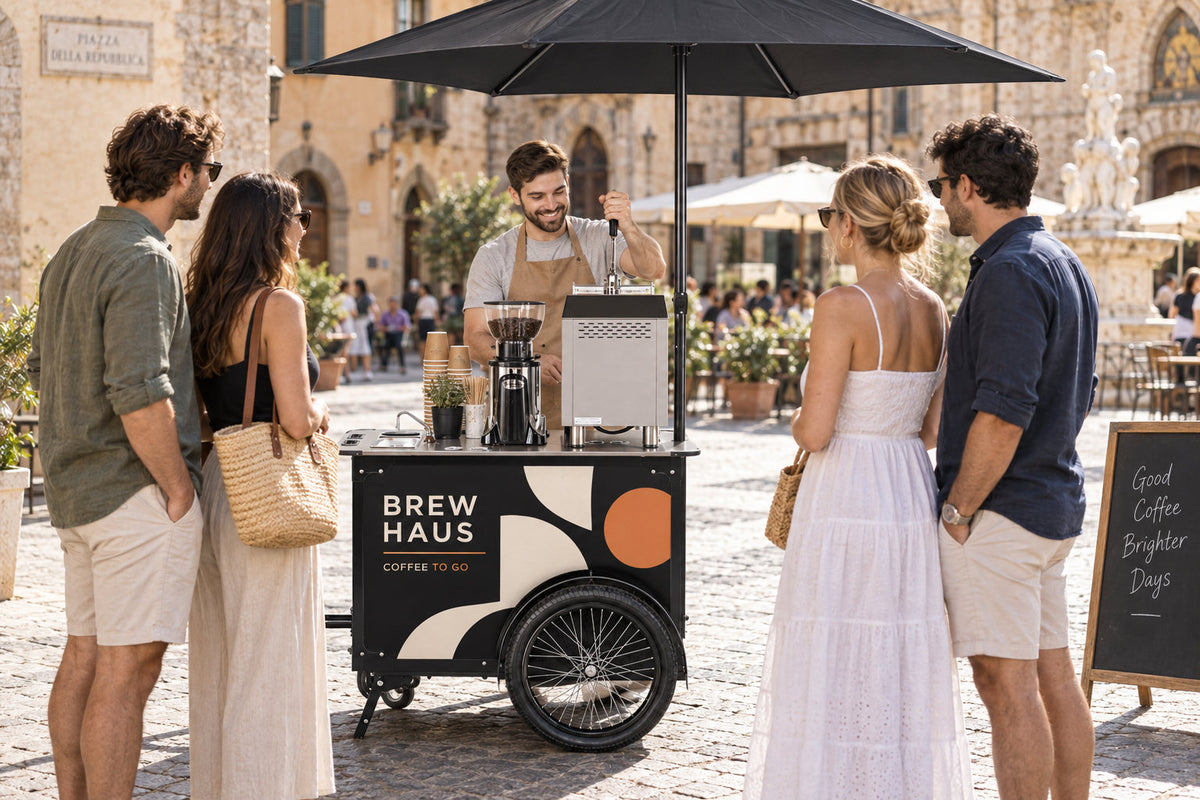
Ice cream, by contrast, is less about simplicity and more about timing. Our “How to Start an Ice Cream Cart Business” guide focuses on seasonality and making money at events, while also dealing with the challenge of selling frozen treats in cooler climates. External guides, like the UK’s Nationwide Caterers Association (NCASS) resource, highlight this issue too. Smart operators create flexible carts that can switch to other products outside of peak season, sometimes even using the same cart for both ice cream and coffee. DeConna’s US guide gives real numbers, estimating used ice cream trucks cost between USD 15,000 and 20,000, plus extra for permits and stock. These numbers show that a well equipped food cart can be a safer way to test the market before moving up to a full truck, another pillar of this library. Coffee is often framed as a romantic lifestyle play. However, serious guides like EHL’s “How to Start Your Food Business: An 8-Step Guide to Success” treat it as what it is: a disciplined hospitality concept that happens to run on wheels. BizzOnWheels’ own coffee cart guide walks through legal steps, location strategy, and the trade offs between compact carts, dual-fuel setups, and fully powered units that can survive long festival days without tripping breakers. Read together, they show how a well specified mobile espresso cart can punch above its weight in corporate atriums, train stations, and festivals. This is especially true when the cart itself is designed as a piece of mobile merchandising rather than a generic stainless steel box.
Outside the BizzOnWheels ecosystem, there are a few external how-to guides worth bookmarking for a broader view. Gala Tent’s “Complete Guide to Starting a Street Food Business” and its equipment guides are aimed at traders using gazebos and pop-up stalls, their analysis of licensing, profit margins, and start up costs often in the £3,000–10,000 range for basic UK setups applies directly to cart-based businesses. Alliance Online’s 2025 street food guide and Startups.co.uk’s updated 2024 walkthrough both cover the full business stack: menu, insurance, permits, marketing, and budget, all explained in plain English. For those who prefer a more global, tech focused approach, Restroworks’ 2025 guide to food carts brings technology EPOS, delivery aggregators, loyalty programs into the conversation from the start.Together, these guides offer a different perspective to BizzOnWheels’ more hardware-focused writing.

Specialized niches need specialized reading. For hot dogs, Toast’s checklist driven article is one of the best mainstream resources, combining basic market research and licensing advice with menu and branding tips for those looking to grow from a single cart to a small brand. Community content like LearnHotDogs.com and the Street Food Pro YouTube channel, where veteran vendor Ben Wilson covers everything from pan sizes to location strategy, gives a candid look at what life behind a hot dog cart is really like including the parts Instagram doesn’t show.

Ice cream and gelato niches have a few surprisingly detailed resources. NCASS’s mobile ice cream guide, though focused on the UK, is honest about seasonality and the risk from non compliant operators undercutting legitimate traders. DeConna’s long running US guide to starting an ice cream truck, along with newer articles from Menubly and SalesPlay, provide real numbers on vehicle costs, stock, and licensing details many lifestyle blogs skip. The message is clear: refrigeration, power, and route planning are just as important as branding. This makes a well designed, eco friendly cart or trike a strong alternative to a full truck in busy cities.

For coffee, there are fewer niche guides, but they are high quality. EHL’s 8-step framework, while not coffee-specific, is especially strong on market positioning, financial modeling, and operational standards. These are the areas that often get overlooked when founders focus on latte art and origin stories. BizzOnWheels’ own guide to coffee carts compares basic, premium, and dual-fuel setups. This helps operators see why a dual-fuel cart might be needed at a busy railway station but unnecessary for a boutique indoor site with stable power.
Once you move beyond the idea stage, the question shifts from “Can I do this?” to “What should I build my business on?” That’s where food cart buying guides are useful. BizzOnWheels’ “How to Choose the Right Food Cart for Your Business” is meant to be read before you look at recipe blogs or logo ideas. It helps future owners think about menu size, power sources, local rules on gas and electricity, and the differences between lightweight push carts and heavier platforms for bike towing or van transports charting the food truck and cart segment point out that mobile formats deliver meaningfully lower fixed costs than restaurants, but that equipment choices lock in everything from daily capacity to the kind of locations available to you. Guides from manufacturers and consultants stress that traders who invest early in compliant, robust commercial food carts rather than improvised DIY builds often recoup the difference via shorter downtime, easier inspections and the ability to trade at higher value events with stricter entry standards. This is where mobile retail solutions really come into their own: the cart becomes a durable, modular asset that can shift between festivals, corporate activations and pop-up collaborations with minimal retooling.
No matter how compelling the cart, nobody should be investing serious money without a business plan. Here, the internet offers abundance, not scarcity, so the challenge is choosing templates that teach you to think rather than simply fill in blanks. BusinessPlanTemplate.com’s food truck template has become a staple because it walks through a full narrative plan and pairs it with a customizable financial model, encouraging operators to stress test margins and cash needs before committing. BusinessPlanTemplate.com, Newer compilations from ClickUp, LivePlan and TRHQ add modern touches like milestone charts and integrated forecasting spreadsheets, reflecting the reality that investors and lenders increasingly expect founders to understand both unit economics and growth scenarios.
If you prefer a more academic approach, EHL’s 8-step guide works as a business planning tool, focusing on market analysis, value proposition, operations, and financials instead of just document structure. In North America, the U.S. Small Business Administration’s general business plan resources are still useful in 2026, especially when combined with industry specific worksheets like Michigan State University Extension’s “Developing a Food Truck Business Concept,” which helps entrepreneurs with positioning and feasibility before they even open Excel. Together, these resources ground the more creative side of street vending in real numbers.
The legal and food safety layer can look intimidating from the outside, but a handful of official hubs make it navigable. In Europe, the European Commission’s food hygiene pages lay out the principles underpinning Regulation (EC) No 852/2004, which still forms the backbone of food safety law across the bloc and continues to influence regimes in aligned countries. The “Your Europe” portal adds a more entrepreneurial lens, explaining how to register a business, handle VAT and use Points of Single Contact in different member states. Creative In the UK, the Food Standards Agency’s “Getting ready to start your food business” guide, last updated in September 2025, sets out a practical checklist for registration, food safety management, allergens and traceability, it is one of the few official resources that speaks directly to small mobile operators rather than only to factories and restaurants.
Beyond those main resources, there’s another layer of compliance focused reading worth your time. Caredemy’s essential guide to starting a street food business treats food hygiene training as a risk reduction tool, not just a bureaucratic step, and shows how it can be done online and updated regularly. Caredemy Ireland’s Food Safety Company helps small operators set up HACCP based systems without getting lost in paperwork, reflecting a wider move toward training and coaching instead of just enforcement. For those operating in or from the United States, the SBA’s food business guidance covers licenses, zoning, health inspections, and financing, which can then be tailored to specific cities.
Once the basics are covered, the next question is usually, “Where can I learn from people actually doing this?” A handful of websites have earned trust as ongoing companions rather than one off articles. Street Food Central, based in the UK, publishes regular pieces on menus, equipment, event strategy and marketing; its writing is grounded in the realities of British weather and council rules, making it particularly useful for operators in that ecosystem. NCASS, the Nationwide Caterers Association, is more than a website: it is the key trade body for independent mobile caterers in the UK, with over 6,500 member businesses and a suite of tools for safety management, training, insurance and advocacy.
In North America, FoodTruckr and Food Truck Empire remain two of the most influential digital platforms. FoodTruckr combines educational articles, a long running podcast archive and marketing advice that leans heavily into brand building and community engagement. Smart Food Truck Empire, built by an entrepreneur who famously generated around USD 60,000 in a year from content and podcasting about mobile food businesses, has evolved into a hub of interviews, case studies, and marketplace listings for equipment and routes. Both sites are invaluable for operators who want to understand the broader economics of mobile food beyond their own city.
Books still matter in an industry that runs on Instagram. The strongest titles have aged well precisely because they focus less on trend driven menus and more on systems. “The Food Truck Handbook” by David Weber remains a standard text, praised for its discipline on permits, operations and finance. Jennifer Lewis’s “Food on Wheels” offers a broader sweep of carts, trucks, and other mobile formats, touching on branding and menu development without losing sight of regulatory considerations. Entrepreneur Media’s “Start Your Own Food Truck Business” brings a pragmatic franchise style structure to planning and growth, while Ben Wilson’s “Hot Dogs Saved My Life” doubles as both a granular operating manual for hot dog vendors and a reminder that mobile food can be a route back from serious financial setbacks. Side For founders building their first serious reading shelf, this quartet provides more durable insight than any number of glossy coffee table books.
If books give you depth, social media communities add real-life detail. Reddit’s r/foodtrucks has become an unofficial back office for the global industry, with honest threads on everything from generator failures to staff theft to the real numbers behind busy weekends. Niche subreddits and Facebook groups focus on specific formats or regions hot dog carts, UK street food traders, equipment trading boards and, while sometimes noisy, they are among the few places where operators openly share both mistakes and successes. For founders deciding between a high-end eco-friendly cart or a basic DIY setup, spending a night reading these threads can be more valuable than any brochure.
Podcasts bring voices into that ecosystem. “KERB On The Inside,” produced by London’s influential street food collective KERB, offers a candid look at how curated markets are built and how traders are selected, mentored and scaled. “The Food Truck Scholar,” hosted by Dr Ariel D. Smith, goes even deeper, unpacking the cultural, social and economic layers of the food truck industry with particular attention to Black-owned businesses and under represented voices; it is both a history lesson and a practical guide disguised as storytelling. Listen Classic episodes of the FoodTruckr School podcast, though no longer in production, still provide nuanced conversations about marketing, route planning and growth from early stage operators. Together, these shows are ideal companions when you are prepping vegetables or driving to a pitch education layered subtly into the rhythms of the workday.
YouTube is still the quickest way to see how a mobile food business really works. LearnHotDogs / Street Food Pro is a popular channel because it shows everything: steam tables, cash boxes, storage, and even the mistakes, all explained by a veteran who values real-world experience. Channels like UpFlip’s food truck series and Marketing Food Online add interviews, site tours, and breakdowns of margins, financing, and marketing, making complex topics easier to understand. For visual learners, these videos turn abstract advice into real examples like queue lines, tight prep spaces, and how staff move inside a small cart.
Formal online courses are a middle ground between YouTube and university. Udemy now offers several food truck focused courses, from “The Food Truck Bible” to business plan and costing modules, for founders who want structured content they can complete in a few evenings. In the UK, NCASS has an online “How to Start a Street Food Business” course that covers legal requirements, finance, equipment choices, and case-study interviews. Many local authorities see this as a sign that an operator is serious. Nationwide and real-world trading, these courses can greatly reduce the trial-and-error period that causes many first-time ventures to fail.
Industry associations and networks provide the long-term scaffolding around all of this. NCASS and the National Market Traders Federation (NMTF) in the UK, Street Food en Mouvement and Food Trucks Association in France, and newer associations in Belgium, North America and Canada all play variations on the same theme: training, lobbying, template documentation and access to events or pitches that unaffiliated traders rarely see. Street For any operator dreaming of scaling beyond a single cart, joining at least one serious association is less about membership badges and more about access to collective memory decades of wins, losses and negotiated compromises with regulators.
Finally, there are the tools that quietly change how you trade day to day. Food Truck Pub is a good example: a free online ordering platform built specifically for food trucks and carts, with integrated mapping, QR codes and direct payments via Square, Clover or PayPal. It allows you to turn long queues into pick-up flows and to capture orders from office workers or brewery customers who would otherwise drift away. Similar systems from providers like UpMenu or local POS firms now target mobile operators explicitly, recognizing that a well designed ordering flow can be the difference between a pleasant lunch rush and chaos. For operators using BizzOnWheels carts at corporate activations, integrating this kind of app based ordering with eye catching, brandable cart design turns a simple serve into a piece of high yield experiential marketing.
Taken together, these resources form something close to an ecosystem. Guides and books help you design a concept. Legal portals and training providers keep you on the right side of regulators. Templates and courses force you to run the numbers. Communities, podcasts and YouTube channels show you what the work actually feels like. Apps and associations help you trade smarter and safer over the long term. Layered underneath it all, the equipment, the cart, the bike, the kiosk is what makes the theory possible on a rainy Thursday in a windswept car park. Choose that equipment wisely, and you give yourself the best chance not just of launching a street food business in 2026, but of still being there, queue snaking along the pavement, when the next wave of would-be vendors starts googling “how to start a food cart business” at midnight.
References
· Global and European food truck / street food market data:
[Source: https://www.mordorintelligence.com/industry-reports/food-truck-market]
[Source: https://www.techsciresearch.com/report/food-truck-market/28773.html]
[Source: https://www.custommarketinsights.com/report/food-truck-market/]
· General street food how-to guides:
[Source: https://www.galatent.co.uk/blog/guides/how-to-start-street-food-business]
[Source: https://www.allianceonline.co.uk/blog/2025/02/the-complete-guide-to-starting-your-own-street-food-business/]
[Source: https://startups.co.uk/guides/how-to-start-a-street-food-business/]
[Source: https://www.restroworks.com/blog]
· Niche hot dog, ice cream and coffee guides:
[Source: https://pos.toasttab.com/blog/on-the-line/how-to-start-a-hot-dog-cart-business]
[Source: https://www.ncass.org.uk/resources/how-to-start-a-catering-business/guides/starting-a-mobile-ice-cream-business/]
[Source: https://www.deconna.com/how-to-start-an-ice-cream-truck/]
[Source: https://hospitalityinsights.ehl.edu/how-to-start-your-food-business]
· Legal and food safety references:
[Source: https://eur-lex.europa.eu]
[Source: https://europa.eu/youreurope/business/index_en.htm]
[Source: https://www.food.gov.uk/business-guidance/getting-ready-to-start-your-food-business]
[Source: https://caredemy.co.uk/starting-a-street-food-business-your-essential-guide/]
[Source: https://www.thefoodsafetycompany.ie/]
· Business plan templates and planning tools:
[Source: https://www.businessplantemplate.com/food-beverage/food-truck-business-plan-template/]
[Source: https://clickup.com/blog/food-truck-business-plan-templates/]
[Source: https://www.liveplan.com/blog/planning/food-truck-business]
[Source: https://www.sba.gov/business-guide]
[Source: https://www.canr.msu.edu/resources/developing-a-michigan-food-truck-business-concept]
· Key websites and associations:
[Source: https://www.streetfoodcentral.com/]
[Source: https://www.ncass.org.uk/]
[Source: https://foodtruckr.com/]
[Source: https://foodtruckempire.com/]
· Communities, podcasts and YouTube channels:
[Source: https://www.reddit.com/r/foodtrucks/]
[Source: https://www.kerbfood.com/podcast/kerb-on-the-inside/]
[Source: https://thefoodtruckscholar.com/]
[Source: https://foodtruckr.com/category/podcast/]
[Source: https://www.youtube.com/channel/UC075i2EB4IGckMoN2MCZFvg]
· Apps and tools:
[Source: https://foodtruck.pub/]
[Source: https://apps.apple.com/us/app/food-truck-pub/id1409399891]
[Source: https://play.google.com/store/apps/details?id=kuhnsoftllc.foodtruckpub]
[Source: https://www.upmenu.com/food-truck-ordering-system/]