Top 10 Low Cost Mobile Business Ideas You Can Start Today (1)
The golden age of entrepreneurship didn’t arrive with billion dollar apps and crypto booms. It arrived quietly, in the form of compact carts, cargo bikes, and modular billboards rolling through city streets. In 2026, the most interesting new businesses are not always venture backed platforms, but nimble, low-cost operations that can set up in a plaza at 8 a.m., cross a park by lunchtime, and cash out before the evening commute. Side hustles have matured into serious income streams: surveys show that roughly seven in ten workers either already have a side hustle or are actively considering one, while more than 60% of adults say they would prefer to be their own boss. The obstacle is rarely motivation, it’s the perception that starting a business requires deep pockets. Mobile retail solutions especially those built around commercial street food carts and bike towed billboards are quietly rewriting that equation.

BizzOnWheels sits at the intersection of these trends. From bespoke food carts for hot dogs, ice cream or crepes, to AdBicy mobile billboards towed by bicycles or operated by foot, the Romanian manufacturer has spent more than a decade designing hardware for people who want to trade, advertise and build brands without signing a 10 year lease. This first part of our series looks at five low cost mobile business ideas that can be launched quickly, scaled gradually and if executed well, pay for themselves far faster than most traditional ventures. They occupy two broad arenas: experiential marketing and street vending innovation in food. Each can be run solo at first, then built out into a small team or agency.

1. Become a Brand Ambassador with Your Own Mobile Billboard
If you strip advertising back to its essentials, most campaigns boil down to a simple proposition: trusted people talking to the right audience at the right moment. That is why word-of-mouth remains the most powerful marketing channel on earth. Nielsen’s long-running surveys have consistently shown that around 90% of consumers trust recommendations from friends and family more than any other form of advertising, while other studies find that roughly three-quarters of people cite word of mouth as a major influence on their purchases. In a world where brands struggle to cut through digital noise, companies are rediscovering the value of human advocates, people who can look customers in the eye, answer questions and hand over a sample or flyer at exactly the right time.
This is where the modern brand ambassador comes in. At one end of the spectrum, ambassadors have become influencer adjacent figures, fronting social campaigns and livestreams, at the other, they are the people you meet in the real world outside stadiums, trade shows, subway exits and festivals. The skill set is deceptively simple being confident, personable, a good listener, comfortable working a crowd but those interpersonal talents are now scarce enough that banks and retailers run competitions to win celebrity ambassadors for small businesses that struggle to promote themselves. For solo entrepreneurs with a strong people instinct, it is an unusually low-barrier entry point: a friendly personality, some basic training and a modest marketing kit can be enough to start earning fees on a project basis.
To turn that freelance role into a more robust business, physical presence matters as much as conversation. Out-of-home (OOH) advertising remains one of the most effective channels for brand recall, report that almost 90% of adults notice an outdoor ad each month, and around 80% say they have engaged with one by searching online, visiting a website or talking about it within the previous 60 days. Combining that media muscle with a human ambassador is where tools like BizzOnWheels’ AdBicy system come into their own. The AdBicy is a modular mobile billboard that can be towed by a bicycle or pushed by hand, with one lightweight aluminum frame converting into several different panel sizes for campaigns of varying intensity. A solo operator with a single AdBicy trailer can move from handing out coupons outside a mall to running small experiential marketing stunts around product launches or ticketed events.
Because the asset itself is eco-friendly pushed or cycled rather than driven it opens doors that conventional ad vans cannot. European OOH specialists have begun leaning heavily on bike based formats in historic city centres and pedestrian zones where vehicles are banned, citing their low emissions and their ability to get “closer to the audience” than trucks with LED screens.For a would-be entrepreneur, that creates a neat triangular proposition: your personality and local knowledge, a brand’s messaging and a highly visible, eco-friendly billboard. The up-front investment for a professional mobile billboard trailer is in the low four figures rather than the tens of thousands usually associated with media assets, which means you can often amortise it over just a handful of well-priced campaigns.

2. Build a Bike Advertising Micro-Agency
For some founders, the goal is not to remain a one-person show but to graduate into running a small outdoor advertising agency. The structural tailwinds are compelling. Digital out-of-home (DOOH) has been one of the fastest growing advertising formats worldwide; in the United States, industry guides show OOH as a top growth medium over the last decade, while GroupM forecasts that DOOH will account for more than 40% of total OOH revenue this year. Telecoms and media giants are buying technology platforms to gain a foothold in the space, as T-Mobile’s recent $600 million acquisition of Vistar Media illustrates. Yet the very nature of OOH distributed, local, hyper contextual means there is still abundant room for nimble operators who can offer brands a more tactile, street-level presence than digital screens alone.
Bike advertising slots neatly into this gap. Specialist agencies across Europe, Africa and North America now run fleets of ad bikes that function as moving billboards, targeting busy shopping streets, waterfronts and event zones. They emphasize the same attributes: low emissions, the ability to reach areas closed to motor vehicles, and high engagement as pedestrians stop to photograph or interact with the bikes. BizzOnWheels’ AdBicy platform was effectively built as the hardware backbone for that model, with its modular frames, quick assembly and compatibility with e-bikes or conventional bicycles. Agencies from France to Scandinavia have adopted the format for campaigns ranging from local retail promotions to national elections.
Starting a micro-agency does demand more structure than freelancing. You need a basic legal entity, professional liability insurance and a clear rate card, as well as simple booking and scheduling software to manage campaigns. But the hard assets remain modest: a handful of bicycles and three or four AdBicy trailers are enough to create a small fleet that can cover multiple districts or events simultaneously.Because OOH campaigns are usually priced on a per-day or per week basis, with rates tied to foot traffic and exclusivity, it is not unusual for a well run agency to recoup the cost of a trailer in a matter of weeks rather than years especially when campaigns are bundled with on-the-ground brand ambassadors. Over time, the business can evolve into a true mobile merchandising and experiential marketing shop, offering sampling, QR-code journeys, social-media contests and data capture, all anchored by the same eco-friendly ad bikes that drew attention in the first place.

3. Run a Hot Dog Cart as a Modern Street Food Business
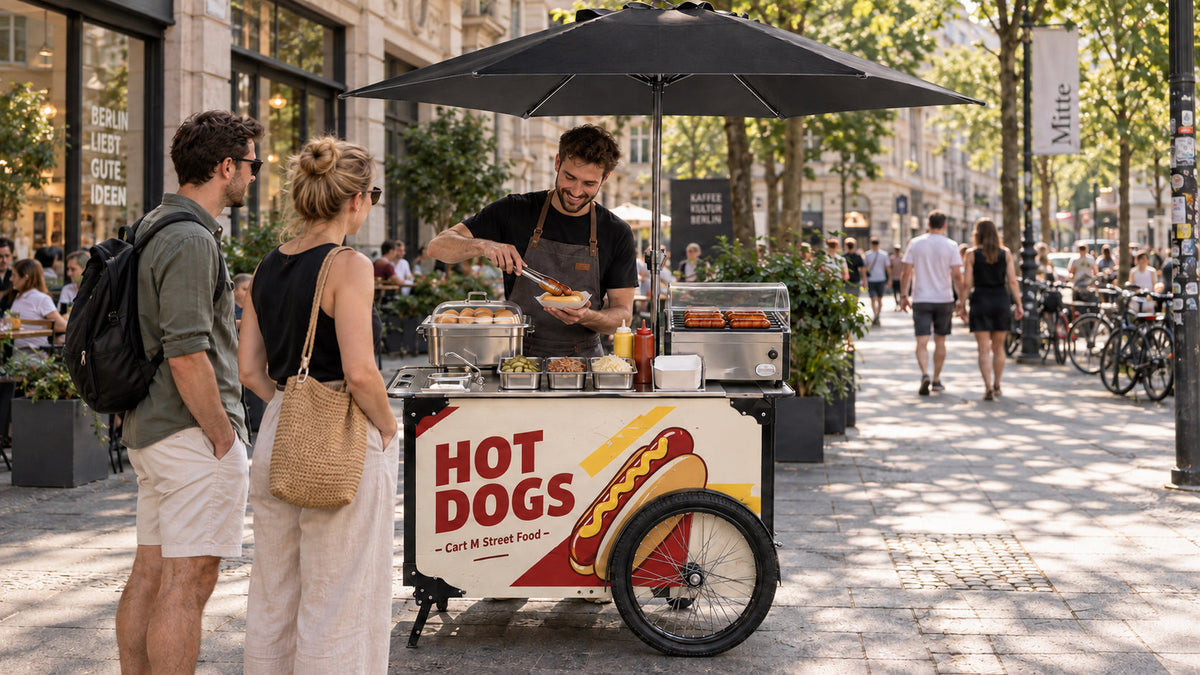
If advertising bikes speak to the head, street food still speaks to the stomach. Few food concepts are as familiar or as forgiving as the hot dog cart. For more than a century, hot dog vendors have anchored corners in New York, Berlin, Copenhagen and countless other cities, trading primarily on convenience and nostalgia. Today, those same carts sit inside a street food market that is worth nearly a quarter of a trillion dollars globally and is expanding at close to 8–9% a year, powered by urbanization, changing work patterns and consumers’ preference for quick, affordable meals. At the lower end of that market, low-overhead carts still make it possible for one or two people to earn a solid living from a single unit.
What makes the model attractive is not that it is easy, it isn’t but that the variables are controllable. A BizzOnWheels hot dog cart, for instance, comes as a ready engineered platform with bike towing capability, stainless steel work surfaces, space for cooking appliances and integrated water management, turning a few square metres into a functional micro kitchen.That means your real work can focus on the business rather than on welding and retrofitting. You still need a grasp of local health and safety rules, food handling certificates and, in many cities, a lottery like process for street vending permits. When public space is hard to access, operators pivot to privately owned locations such as brewery courtyards, markets, car parks, events and sports grounds, where landlords are often more entrepreneurial.
The economics are appealing enough to justify this bureaucratic grind. Sausage and bun costs are predictable; toppings can be scaled up or down depending on your positioning; and labour can often be limited to one or two staff per shift. Because the cart itself is relatively inexpensive compared with building out a permanent kiosk, many operators report paying back their initial investment within a season or two, assuming they secure consistent locations and trade even in cooler months. For founders who like being outdoors, enjoy banter and are willing to do the unglamorous work, cleaning equipment, hauling supplies, setting up and closing down, it can be both a lifestyle and a business.

4. Turn an Ice Cream Cart into a Seasonal Cash Machine
Ice cream occupies a special place in the food ecosystem: it is both an everyday treat and a small luxury, which is why the global ice cream market, currently worth close to $90 billion, continues to grow even as health conscious narratives gain ground. Within that space, mobile ice cream businesses trucks, tricycles and carts benefit from unusually strong margins. Recent industry analyses suggest that mobile operations can achieve net profit margins of 20–30%, helped by relatively low overheads and the ability to chase warm weather and crowds.
An ice cream cart is effectively a profit engine on wheels. BizzOnWheels’ Ice Cream Cart XL, for example, combines display freezers, storage, toppings space and a built-in hand-wash area on a chassis that can be both pushed and bike-towed. That dual mode lets you trade inside malls, at corporate campuses or on promenades, then hitch the same unit to an e-bike for festivals, concerts or beachside shifts. Unlike a brick-and-mortar scoop shop, your fixed costs are limited: no rent, minimal utilities, no extensive fit-out. The trade off is seasonality. Revenue tends to spike in the summer and drop sharply in colder months, though some operators counter this by switching to hot drinks or waffles in winter, using the same cart footprint with different equipment.
From a brand building perspective, ice cream is social media gold. The product is inherently photogenic; the emotional association is overwhelmingly positive; and the very act of buying a cone at a festival or waterfront is often part of a shared moment people are eager to document. That dovetails neatly with BizzOnWheels’ emphasis on bespoke food carts that function as mobile billboards in their own right, with high-impact graphics and clean lines designed to look good on camera. An operator who pairs that visual presence with smart location choices near playgrounds, tourist sites, stadiums or high-footfall parks can achieve strong average daily takings without needing a huge menu.

5. Serve Crepes from a Compact Cart
If hot dogs are the workhorses of street food, crepes are its quiet sophisticates. Originating in France and long associated with Brittany and Parisian street corners, crepes have evolved into a pan European staple, appearing at Christmas markets in Germany, festivals in Central Europe and tourist zones from Lisbon to Ljubljana.Their appeal lies in versatility: the same thin pancake can be filled with Nutella and banana for children, ham and cheese for commuters, or regional specialties such as Hungarian hortobágyi palacsinta stuffed with stew. For an entrepreneur, that means one core production method batter, ladle, spread, flip can support a surprisingly wide range of price points and customer profiles.
A crepe cart business shares many structural traits with a hot dog or ice cream cart, but with slightly higher perceived value. BizzOnWheels offers dedicated Crepes Cart configurations, typically built around one or two professional crepe plates, refrigerated storage for fillings, integrated sinks and generous serving counters, all on a chassis that can be pushed or towed by a bicycle. This combination allows an operator to serve morning commuters with savoury galettes, lunchtime crowds with vegetarian options and evening tourists with dessert crepes often at the same location but at different times of day. Because the raw materials are relatively inexpensive (flour, eggs, milk, sugar) and the fillings are modular, gross margins can be robust once you have reached a basic level of skill and speed.
Regulation for crepe carts tends to mirror other hot food vendors: you will need to demonstrate compliance with local food safety standards, secure a street trading licence where applicable and, in many jurisdictions, provide on board handwashing and adequate ventilation, especially when working indoors or under tents. The reward for navigating that complexity is a business that feels both cosmopolitan and accessible. At a time when European street food festivals market themselves on the diversity of their offerings from Mexican tacos to Slovak palacinke crepes remain a cross cultural comfort food that draws lines in almost any setting.
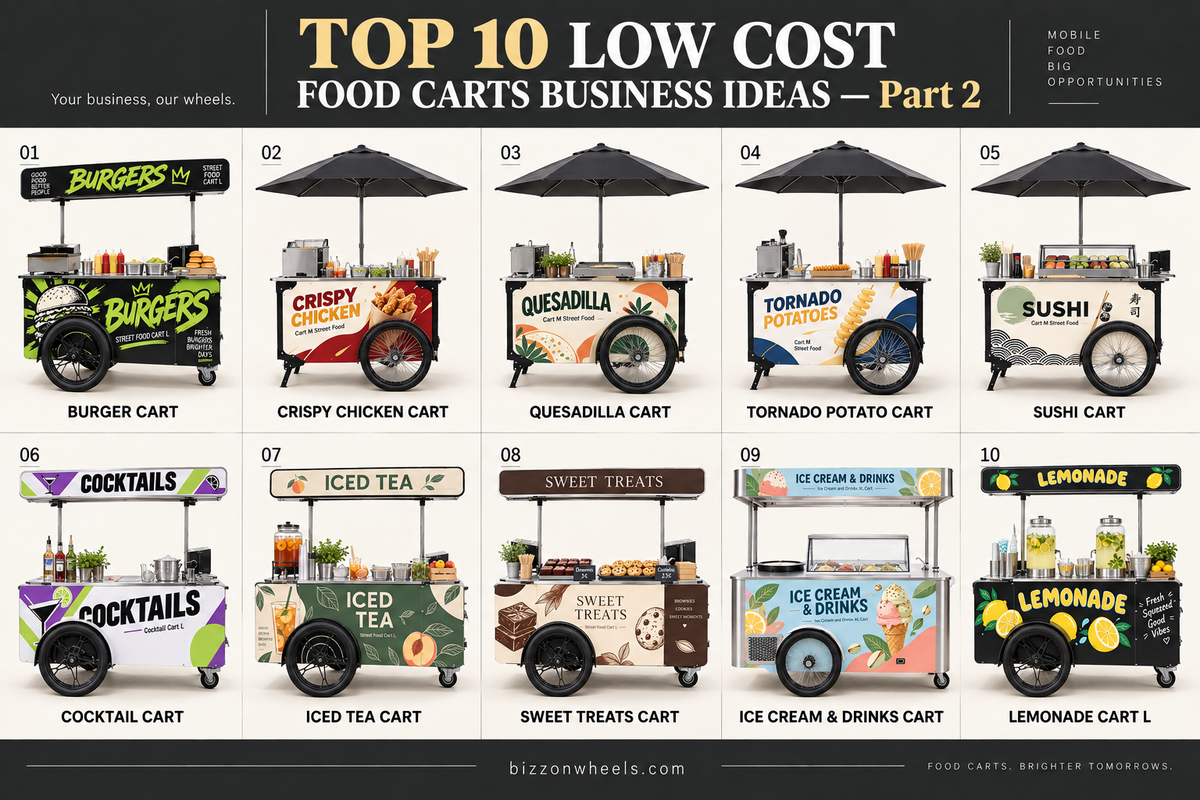
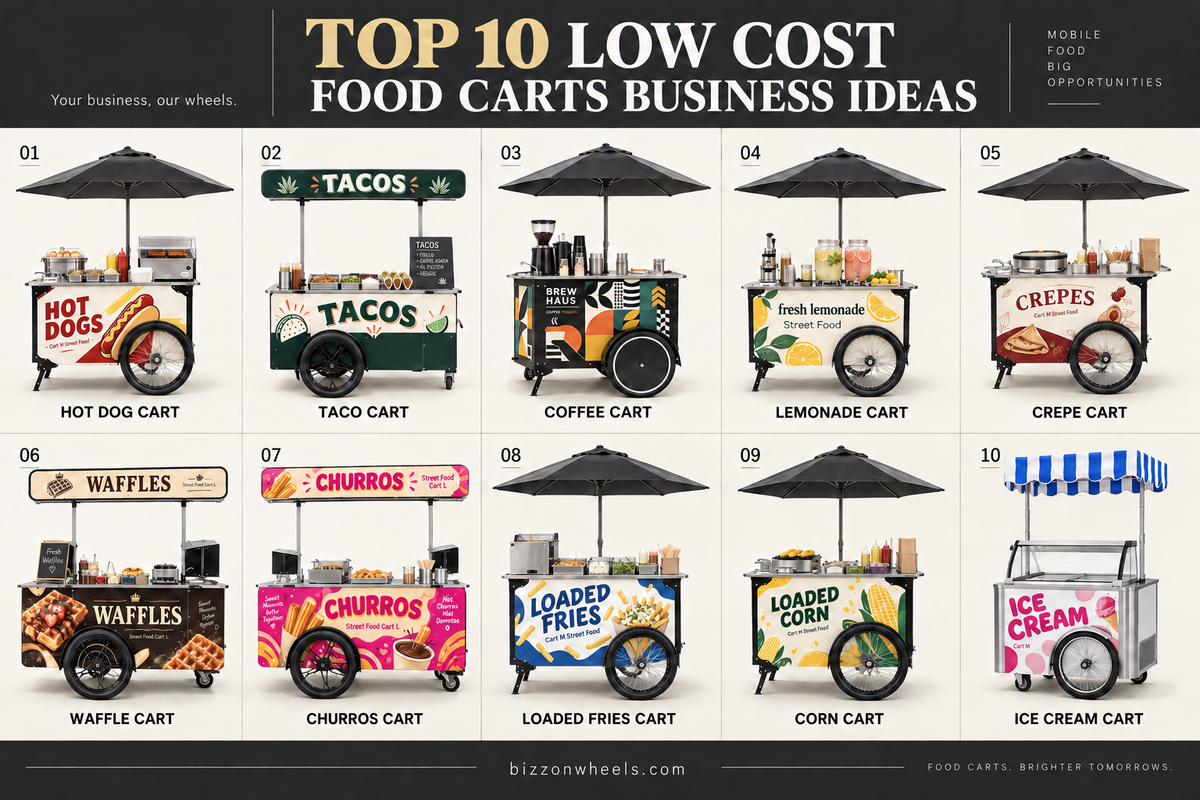
These five ideas: brand ambassador with a mobile billboard, bike advertising agency, hot dog cart, ice cream cart and crepe cart share a simple DNA. They are low-cost, modular and mobile, designed to plug into the growing demand for local experiences, street vending innovation and eco-friendly commerce without requiring life altering amounts of capital. They also share a common hardware backbone: robust, bike towed or pushable platforms that double as both workspace and visual identity. In the next part of this series, we will look at additional concepts coffee carts, juice bars, cocktail bikes and more that build on the same principles. For now, the question is not whether there is demand for what you could serve or promote on the street. The numbers suggest there is. The question is whether you are ready to roll something of your own out onto the pavement.
References (for linking)
-
Nielsen – “Under the Influence: Consumer Trust In Advertising”
https://www.nielsen.com/insights/2013/under-the-influence-consumer-trust-in-advertising/ Nielsen -
BusinessNewsDaily – “Why Word of Mouth Trumps Traditional Advertising”
https://www.businessnewsdaily.com/2353-consumer-ad-trust.html Business News Daily -
Buyapowa – “88% of Consumers Trust Word of Mouth”
https://www.buyapowa.com/blog/88-of-consumers-trust-word-of-mouth/ Buyapowa -
OAAA – “The Value of OOH: 2024 Guide”
https://oaaa.org/wp-content/uploads/2024/02/2024-Value-of-OOH-Guide.pdf OAAA -
StackAdapt – “OOH Advertising Stats Every Marketer Should Know”
https://www.stackadapt.com/resources/blog/ooh-advertising-statistics StackAdapt -
PPC Land – “DOOH proves effective video mix partner as new study reveals 90% recall rates”
https://ppc.land/dooh-proves-effective-video-mix-partner-as-new-study-reveals-90-recall-rates/ PPC Land -
Grand View Research – “Food Trucks Market Size & Trends”
https://www.grandviewresearch.com/industry-analysis/food-trucks-market-report Grand View Research -
Future Market Insights – “Food Truck Market Outlook”
https://www.futuremarketinsights.com/reports/food-truck-market Future Market Insights -
DojoBusiness – “Street Food Market: Growth and Global Trends”
https://dojobusiness.com/blogs/news/street-food-market-growth BusinessDojo -
Hostinger – “Side hustle statistics 2025: Income, trends & insights”
https://www.hostinger.com/ca/tutorials/side-hustle-statistics Hostinger -
Gallup / Shopify – “Desire to Be Own Boss Widely Held in U.S.”
https://news.gallup.com/poll/645593/desire-own-boss-widely-held.aspx Gallup.com -
Intuit QuickBooks – “The rise of self-employment in 2025”
https://quickbooks.intuit.com/uk/blog/the-rise-of-self-employment-in-2025/ QuickBooks -
Carry – “2025 Gig Economy Trends for Freelancers and Self-Employed Workers”
https://carry.com/learn/gig-economy-trends-for-freelancers-and-self-employed-workers Carry -
Minnesota DEED – “A Surge in Self-Employment”
https://mn.gov/deed/newscenter/publications/trends/mar-2025/nonemployer.jsp mn.gov // Minnesota's State Portal -
BizzOnWheels – Main site and About page
https://www.bizzonwheels.com/ -
BizzOnWheels – AdBicy L and M mobile billboards
https://www.bizzonwheels.com/products/adbicy-l-advertisign-bicycle-trailer
https://www.bizzonwheels.com/products/adbicy-m-advertising-bike-trailer -
BizzOnWheels – AdBicy customer gallery and blog
https://www.bizzonwheels.com/pages/gallery -
BizzOnWheels – Food carts catalogue (including Hot Dog Cart, Ice Cream Cart XL, Crepes Cart L)
https://www.bizzonwheels.com/collections/food-carts -
BizzOnWheels – YouTube channel (food carts and hot dog/crepe business ideas)
https://www.youtube.com/@BizzOnWheelsOwner
https://www.youtube.com/watch?v=8uoUtlHC8J0 YouTube+1 -
Reuters – “T-Mobile to acquire Vistar Media for $600 Million to bolster advertising business”
https://www.reuters.com/markets/deals/t-mobile-acquire-vistar-media-600-million-bolster-advertising-business-2025-01-13/ Reuters -
Bike advertising and mobile billboard agencies
https://www.bizzonwheels.com/blogs/bizzonwheels-blog/adbicy-mobile-billboards-buyer-s-guide-advantages-applications-and-best-practices
https://cominvader.net/en/bike-advertising/ Cominvader
https://www.outdoor-ads.co.za/bikes-advertising-services/ outdoor-ads.co.za
https://www.mobilemarketingaustralia.com.au/bike-boards Mobile Marketing Australia -
Toast – “How Much Does an Ice Cream Shop Make? (2025 Data)”
https://pos.toasttab.com/blog/on-the-line/ice-cream-shop-revenue pos.toasttab.com -
7shifts – “How Profitable Is an Ice Cream Shop?”
https://www.7shifts.com/blog/ice-cream-shop-profitability/ 7shifts -
Widermatrix – “How Profitable Is an Ice Cream Machine? A 2025 Business Analysis”
https://widermatrix.com/how-profitable-is-an-ice-cream-machine-a-2025-business-analysis/ widermatrix.com -
Avellera – “Street Food Culture in Europe”
https://avellera.com/street-food-culture-in-europe/ avellera.com -
TasteAtlas – “Best Rated Street Food Sweets in Western Europe”
https://www.tasteatlas.com/best-rated-street-food-sweets-in-western-europe TasteAtlas -
VS Veicoli Speciali – “The Most Beloved Sweet Street Foods in Europe”
https://www.vsveicolispeciali.com/en/the-most-beloved-sweet-street-foods-in-europe/