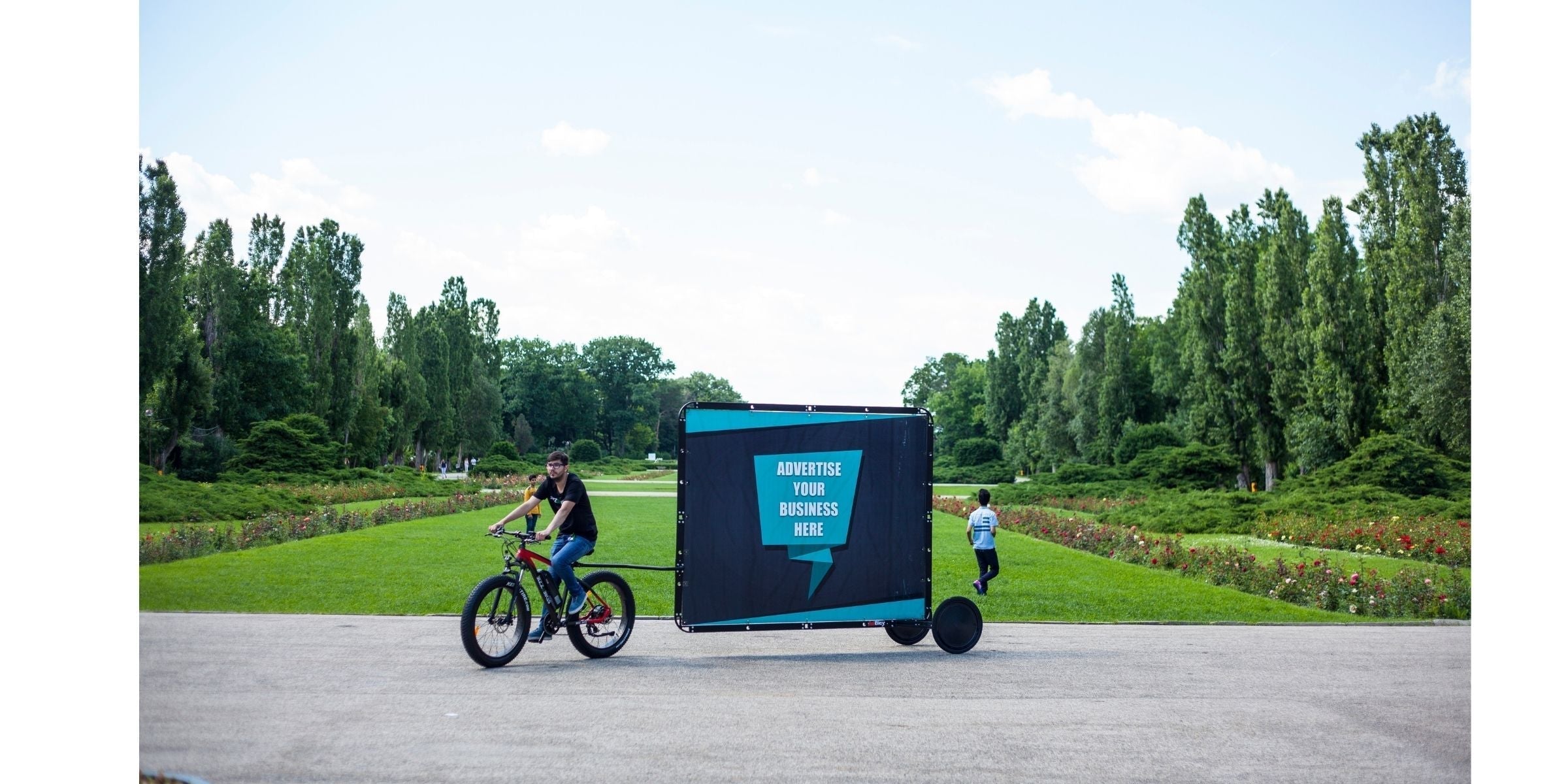
How To Start A Bicycle Advertising Business: Turning Eco-Friendly Mobility Into A Profitable Media Network
Cities are packed with ads, but people notice them less than ever. Commuters scroll quickly past mobile ads, skip video spots, and ignore the digital noise around them. Yet one type of advertising still gets attention: something surprising, at street level, and right where people walk. Bicycle advertising with AdBikes, promobike units, and AdBicy mobile billboards—has grown from a “quirky” idea into a real business. If you can think like a publisher and manage operations well, you can start a bicycle advertising agency with modest funds and turn it into a lean, profitable network.

Outdoor advertising is a large industry. In 2023, the global out-of-home (OOH) market was valued at about $29 billion and is expected to reach $63 billion by 2032, growing at roughly 10% per year. While digital ads get most of the attention, brands are discovering that physical ads can build trust and recognition in ways online banners often can’t. Digital OOH formats such as screens in transit hubs, malls, and along roads have already surpassed $20 billion worldwide and are expected to double again over the next decade. As cities restrict large billboards and bright screens to reduce visual clutter and improve safety, they are making room for lighter, more flexible options like bicycle mobile billboards. Recent policy changes in cities from Los Angeles to Mumbai show that while authorities are cautious about large, static signage, they are more open to smaller, human-powered ads that move with traffic and do not block sightlines.
A bicycle advertising business brings together three major trends: the growth of OOH, the rise of experiential marketing, and pressure on brands to reduce their carbon footprint. Research shows that live, in-person experiences perform much better than traditional ads. For example, about 85% of customers are more likely to buy after attending an event or brand experience, and around 90% of marketers say these campaigns increase engagement. A branded fleet of AdBikes or mobile billboards works like a mini-event on the move easy to see, photograph, and interact with without the cost of a full pop-up. In addition, bicycle media operators emphasize the “green” advantages: no emissions, low noise, and almost no waste compared to classic OOH. For brands that want to demonstrate real climate action, a promobike campaign is strong proof.

Before you think about fleet size or profits, remember that city rules come first in this business. Mobile billboard regulations vary from city to city. In some places, mobile advertising displays including billboards on bicycles are strictly limited or even banned when parked on public land, often for safety reasons or to reduce visual clutter. Other cities have rules about the size, lighting, or movement of mobile billboards, which affects where and when you can operate and what kind of lighting you can use. Knowing these rules better than your competitors can actually become an advantage. A smart operator starts by learning local regulations, talking with city officials, and when possible positioning the fleet as part of sustainable transport, not just advertising. This groundwork can make the difference between building a scalable business and running one-off campaigns that risk being shut down.
Once you’ve clarified the rules, focus on daily operations. Successful agencies often operate more like small logistics hubs than creative studios. You need a secure, easy-to-access space to store your mobile billboards and bikes large enough to move frames around, store spare panels, and, over time, manage a growing fleet. At first, a corner of a warehouse may be enough, but over time this space becomes the heart of your business. You’ll also need a small nearby workshop with basic bicycle tools, a wheel truing stand, spare tires and tubes, lubricants, and extra fasteners for the billboard frames. The best OOH asset is one that can leave the depot every morning without repairs. Regular maintenance keeps campaigns running and shows agency partners they can rely on you so they don’t have to explain to clients why some units are suddenly “off duty.”

As you win more clients, your campaigns will need to reach areas that are too far for a cyclist to cover in a single day. That’s when transport becomes important. A small van or a trailer that can carry multiple AdBicy units lets you run campaigns in different neighborhoods or even other cities without increasing your fixed costs too much. It also protects your brand image: bikes arrive clean, on time, and ready to go, instead of being ridden long distances before the workday starts. Some operators drop bikes off in the morning and pick them up in the evening, treating them like media assets that can be moved as needed.
Every successful bicycle advertising campaign depends on people who act as brand ambassadors, cyclists, and street-level observers. Building a promoter base is more than paperwork; it’s an investment in your ability to deliver experiential marketing at scale. Studies in tourism and retail show that well-designed experiences lead to higher engagement and loyalty. Riders are at the center of these experiences. Instead of hiring anyone who has a bike, good operators select promoters for attitude and reliability, then train them in brand basics: where to park the bike, how to answer questions from passersby, when to gather feedback, and how to stay aware of the local area. Over time, you’ll learn which promoters are best for launching fitness brands, who performs well at festivals, and who is suited for quiet, all-day work in business districts.
Once operations are in place, the next question is: who will pay for your service? Early revenue usually comes from local businesses that want to be seen in their neighborhood but can’t afford large billboards or ongoing digital ads. Gyms, cafés, quick-service restaurants, and independent shops are excellent first clients. They care about clear results: more foot traffic, more website visits from the area, and more sign-ups. For example, a local gym in Manchester used a week-long bike billboard campaign and saw roughly a 40% increase in membership enquiries and a 25% increase in sign-ups. When you can show that a fleet of AdBicy units drives real revenue growth for a business, your work starts to speak for itself.

The biggest growth comes from partnerships, not just direct sales. Traditional agencies, OOH specialists, and experiential marketing firms are always looking for new, safe formats to add to campaigns. Many already run pop-ups, roadshows, and festivals, so bicycle mobile billboards fit perfectly. A BizzOnWheels style approach where you supply AdBicy units and manage on-street execution allows agencies to include your service in proposals without building their own operations team. BizzOnWheels has shown that planned routes, coordinated deployments, and creative ideas can make a bike fleet the link between online and offline campaigns. When you speak to agencies, you’re not just offering bikes and billboards; you’re offering a ready-to-run, measurable format that fits their existing strategies.
Pricing is where many new operators make mistakes either charging too little or scaring off serious clients. Instead of picking a random daily rate per bike, set prices the way a media planner would. Agencies think in terms of cost per thousand impressions (CPM), reach, and frequency. You may not have the same pedestrian traffic data as big OOH networks, but you can use public pedestrian and traffic data alongside your own counts. The key is to offer clear packages: maybe three promobike units in a small area for a week, a citywide launch with a dozen AdBicy mobile billboards for a month, or a regular weekend-and-events presence. Successful case studies like the Manchester gym hould be evaluated after the campaign to highlight return on ad spend. As your reputation grows, you can start charging more for peak days, premium locations, and last-minute bookings.
Today, if you can’t show proof, it’s as if the campaign never happened. That’s why documenting campaigns isn’t just a nice extra it’s essential. Promoters should be trained to take photos and short videos of the promobike in key spots, ideally with recognizable landmarks and crowds in the background. These images and videos feed into campaign reports that cover routes, estimated impressions, interactions, and any street-level feedback. Brands often use this content on their own social media, turning a physical campaign into social proof. Done well, a single campaign report can lead to several new projects especially when clients can show that their spend delivered both visibility and reusable content.
Beyond the creative side, this business depends on cost control. A lean bicycle advertising agency keeps fixed costs low: affordable rent, a fleet that grows only when needed, and promoters paid mainly per campaign. A solid business plan helps you anticipate seasonality, cash flow, and growth for example, how many bikes you need to reach break-even, what to do if a major client stops spending, and how quickly you can move bikes between markets. Registering as an advertising or media services provider isn’t just for taxes; it also shows agencies and big brands that you’re a legitimate, insured partner not someone running this as a side project.
Your own brand is often the most overlooked client. Any slow week is a chance to use your fleet as a live case study for your business. By attending trade fairs, local festivals, and industry events with AdBicy units on display or parked near entrances, you demonstrate the format’s impact in real time and put yourself in front of the right decision-makers. Surveys in the event industry show that in-person experiences are now among the most trusted and effective marketing channels, which supports the idea of treating your own presence as an ongoing campaign. When your bikes advertise your business, every kilometer supports both your service and your growth.
Like any new business, starting a bicycle advertising agency takes patience and a willingness to accept slow progress at first. Early campaigns may have thin profits as you build your portfolio, refine routes, and test operations. Over time, however, the real value of your business shifts from the bikes themselves to the network you’ve built: regulators who know you, promoters who trust your instructions, agencies that count on your reliability, and local businesses that see your promobike units as part of their own success. Today, when brands need to show both creativity and responsibility, a well-managed fleet of eco-friendly mobile billboards is more than just a smart idea. It’s a timely, reliable media asset that turns cycling into a business that moves both markets and people.
References
https://www.zionmarketresearch.com/report/out-of-home-advertising-market-size
https://www.imarcgroup.com/digital-ooh-market
https://www.limelightplatform.com/blog/experiential-marketing-statistics
https://exposureanalytics.com/blog/5-experiential-event-statistics-to-inspire-your-next-event/
https://codelibrary.amlegal.com/codes/los_angeles/latest/lamc/0-0-0-214564
https://ecode360.com/43347970
https://cityclerk.lacity.org/onlinedocs/2011/11-1532-s3_ORD_185145_8-31-17.pdf
https://www.toronto.ca/legdocs/mmis/2010/ls/bgrd/backgroundfile-29509.pdf
https://thebikeads.co.uk/blog/ooh/case-study-the-success-of-a-bike-advertising-campaign-for-a-local-gym-in-manchester/
https://blackravenmedia.com/push-bikes/
https://iprjb.org/journals/IJSMP/article/view/2456
https://management.ifrel.org/index.php/ManagementDynamics/article/view/198/113
https://learn.g2.com/experiential-marketing-statistics
https://bizzonwheels.com/pt/create-successful-bike-advertising-campaigns-adbicy-mobile-billboards-2/
https://timesofindia.indiatimes.com/city/mumbai/mumbai-civic-body-releases-new-outdoor-advertisement-policy-says-no-hoardings-on-footpath-or-building-terrace/articleshow/125617927.cms