Before You Brew: Six Rules For Turning A Coffee Cart Into A Serious Business
Choosing a coffee cart is a strategic move that shapes how your brand grows and where you can operate. With the global coffee shop market worth over $220 billion and growing 4 to 5% each year, many operators want options that are cheaper and faster to launch than traditional cafés. Street food and mobile foodservice are now mainstream, and food trucks and carts are common in cities. In Europe, the food truck market is expected to grow by more than 7% a year until 2030. In this setting, coffee carts and similar setups like coffee bikes, stands, kiosks, and pop-ups have become real business platforms. For Bizz On Wheels, mobility is at the core of that platform.

Experts predict the global coffee cart market will reach about $4.22 billion in 2025 and could grow to $7.9 billion by 2033, with an annual growth rate of around 7.2%.
This growth isn’t just about nostalgia for quirky carts. It’s driven by operators who see the cart as their main business tool. The size of your cart affects how many drinks you can serve during busy times. Its footprint determines what licenses you can get, whether you’re in an office lobby, on a busy street, or at a festival. The way it’s built affects your costs, including water supply, power, cold storage, and durability. So before you focus on branding, you’re really choosing a small-scale café platform.

Bizz On Wheels focuses on professional coffee carts and towable trailers, available in two sizes: L and M. Unlike fixed kiosks, makeshift stands, or fully built-in coffee bikes, these carts can work as stand-alone mobile cafés or be turned into bike trailers for a regular bike or e-bike. Choosing sturdy, towable carts is a practical choice. It fits the trend in mobile retail for flexible systems that can be used in different ways throughout the day, such as staying outside a metro station in the morning, being towed through a park in the afternoon, or serving as a branded pop-up at night.
To compete seriously, a coffee cart needs to work as real infrastructure, not just as a display. This starts with the coffee machine. Many mobile operators now use dual-fuel espresso machines that run on LPG or butane when off the grid and switch to electricity when it’s available. Companies like Fracino have developed product lines for this need; their Contempo and Retro dual-fuel machines are made for mobile use, combining LPG with 12V battery systems to match the performance of a fixed café. On a Bizz On Wheels cart, pairing this type of machine with a commercial grinder built for constant use turns the cart into a true production unit, ready for busy service, not just the occasional coffee.

A business-ready cart must be self-sufficient, not just able to make coffee. Health rules in Europe and other regions now require running water, hand-washing stations, and proper separation of clean and waste water—standards that became stricter after the pandemic and are now common in food-service licensing. A professional cart needs a closed water system with stainless-steel sinks, a pump, a 12V battery, and the right size tanks for fresh and waste water. Bizz On Wheels includes these features as standard in both L and M carts, adjusting details to meet local codes. For operators, this careful design means fewer regulatory worries and helps ensure inspectors see the cart as a real, compliant café, not just a side project.
Cold storage and power management set advanced carts apart from basic ones. In places where milk and other perishables must stay cold, ice-filled coolers don’t work for long. That’s why over 60% of coffee cart operators now use eco-friendly options like solar power and efficient refrigeration, as seen in Bizz On Wheels carts. These carts are built to fit cold boxes or 12V mini-fridges, LPG tanks, and optional solar panels and batteries. This setup lets baristas keep milk, syrups, and other perishables at safe temperatures all day, whether the cart is parked in a business park or moving along the waterfront.

Bizz On Wheels offers two main cart sizes. Bizz On Wheels offers two main cart sizes. The L-size cart is the flagship, designed as a full mobile café that can handle busy times like those in major coffee chains. It fits a dual-fuel espresso machine, grinder, LPG tank, cold storage, and a full water system. Features include a stainless-steel worktop, built-in knockbox, plenty of storage, and a folding roof with side panels for weather protection and branding. The Basic Coffee Cart L covers the essentials, providing the structure and hygiene basics while leaving space for operators such as specialty cafés, roasters, or equipment makers—to add their own machines and accessories. This makes it ideal for brands that already have their preferred equipment and want a strong, neutral base., the Premium Coffee Cart L offers a different solution. It uses the same L-size base but comes fully equipped and ready to use from day one. It includes a dual-fuel Fracino machine, matching grinder, folding countertop extensions, and a solar-ready electrical kit, all installed and tested in advance. Indigo Valley. This makes it a true “coffee shop in a crate” for new entrepreneurs, large companies launching branded coffee services, or hospitality groups testing mobile formats. For investors, this setup shortens the time between spending money and making the first sale, turning the cart into a revenue source faster.

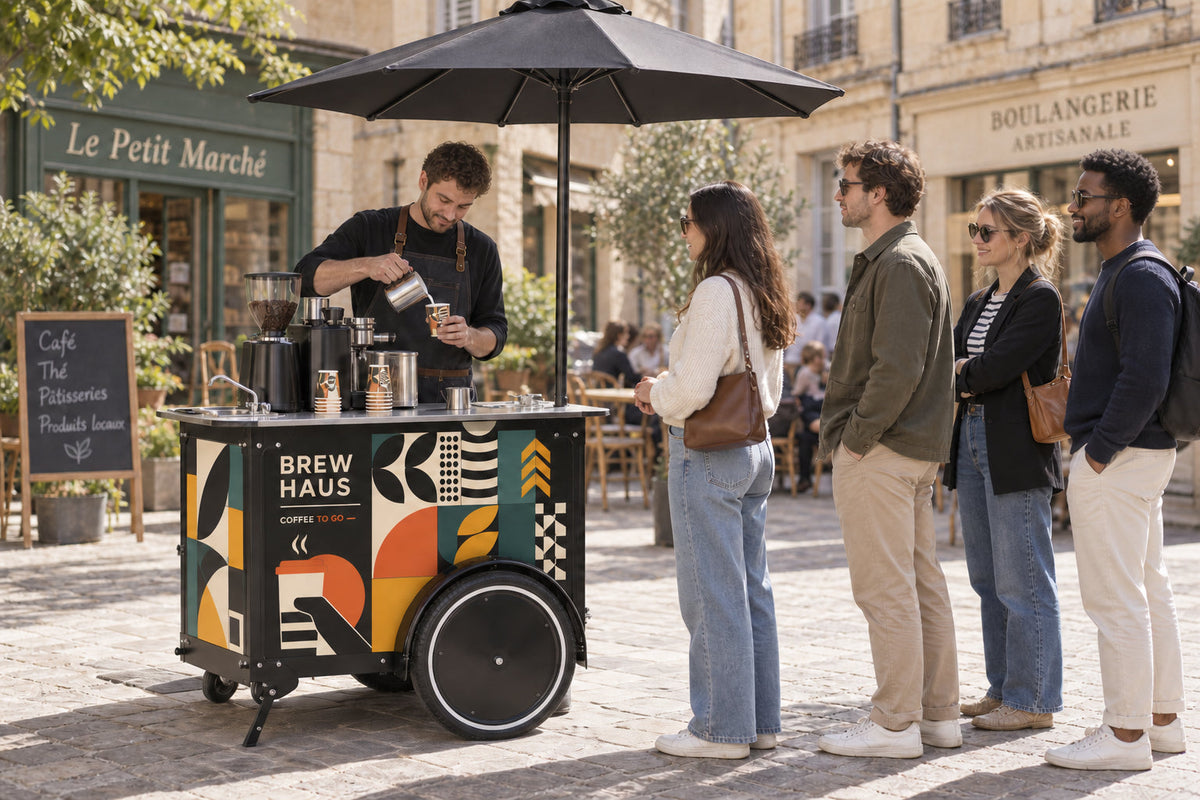
While L-size carts are built for high volume, the Coffee Cart M is all about flexibility. This smaller cart is easy to move into tight spaces like hotel lobbies, small plazas, or trade show aisles where larger carts can’t fit. It still includes key features: a stainless counter, knockbox, automated water kit, storage, and a large umbrella for shelter and branding. Its size makes it perfect for situations where being seen is as important as serving many customers. Brands use M-size carts for product launches, as mobile sampling stations at festivals, or as premium pop-ups in busy areas where a permanent setup isn’t needed. In these cases, the cart works as both a workspace and advertising.
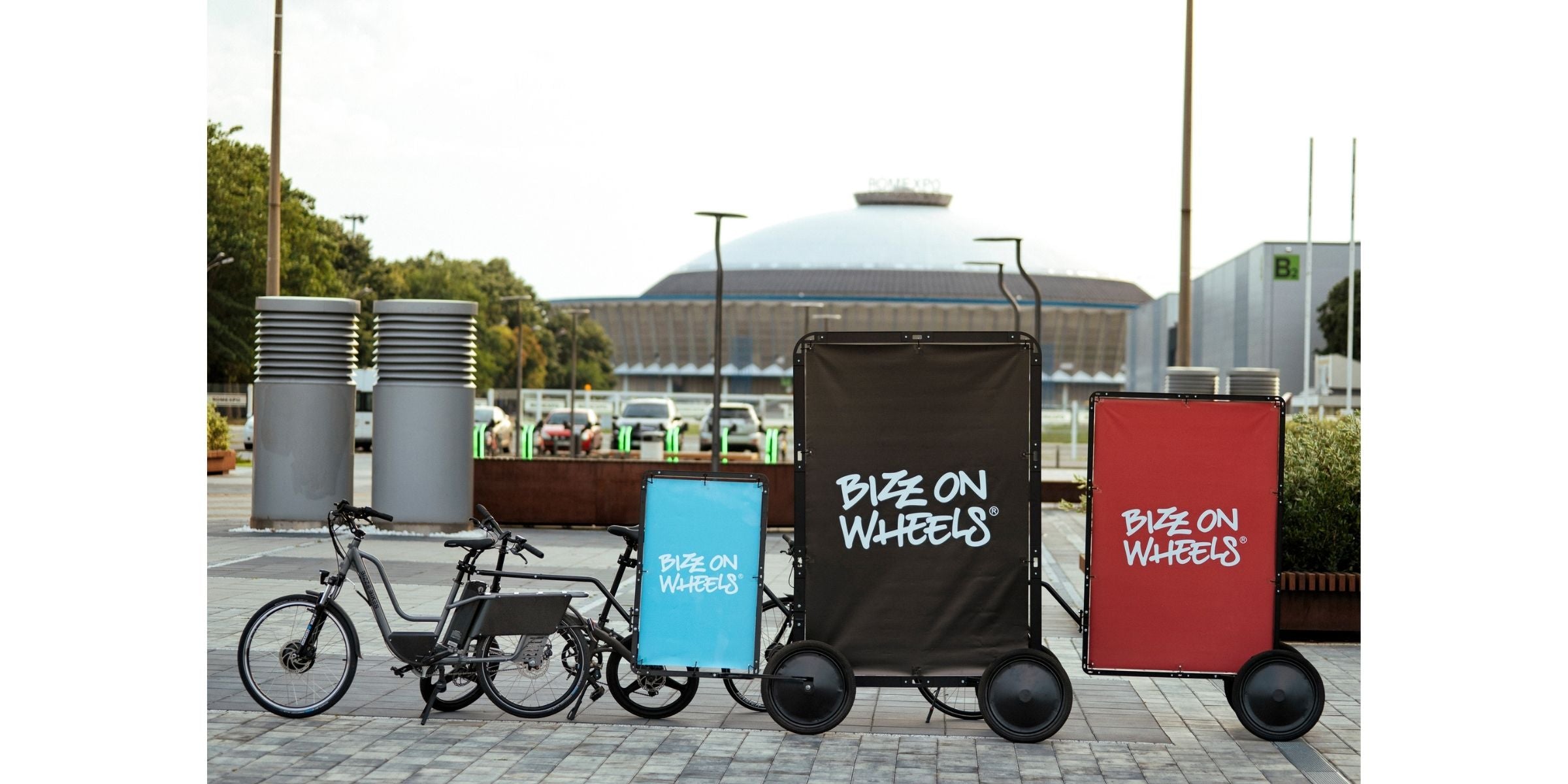
Bizz On Wheels stands out by making its carts separate from the bike or towing system. Instead of building dedicated coffee bikes, the company designs carts that can become bike trailers with a universal hitch. This approach matches the trend in small-scale retail for flexible, modular setups instead of single-use designs. Studies of bike-based food carts, like Wheelys Café and other European models, show that pedal-powered carts can work as full cafés with smaller environmental impacts and strong visual appeal. By offering towing as an option, Bizz On Wheels gives operators the flexibility to tow a cart behind a bike in the morning, then set it up as a stationary unit later in the day, all without needing a van.
Choosing between an L or M cart, or between a stationary or trailer setup, depends on your business needs, not just appearance. Established cafés, roasters, and coffee brands often see the cart as an extension of their current setup. Their main question is, “What role will this cart play for my brand?” For those looking to expand into festivals, corporate events, or outdoor locations, the Basic Coffee Cart L provides the infrastructure to use their own dual-fuel machine and grinder, keeping mobile quality high. When the focus is on customer experience or sampling like a roaster introducing a new coffee the smaller Coffee Cart M is often more flexible.
New mobile coffee entrepreneurs have different priorities. They’re not just buying equipment they want to know the cart will support a real business. Studies of specialty coffee carts show that gross margin, net margin, and average transaction value are key performance indicators.
For those who want to launch quickly, the Premium Coffee Cart L lowers the risk by being ready to operate like a small café from day one, able to handle busy spots like transport hubs or campuses. Entrepreneurs who want a lighter, more mobile setup such as for farmers’ markets or community events often choose the M-size cart as a bike trailer, trading some capacity for greater mobility and easier towing.
Corporate clientCorporate clients, hospitality groups, and agencies often think in terms of fleets, not just single carts. In these cases, L-size carts serve as semi-permanent setups, such as a group of mobile cafés in a business park, a main feature in a food court, or a branded kiosk at a stadium entrance. At the same time, M-size carts are used as mobile units, sent to lobbies, meeting rooms, special events, or outdoor activities where a large cart wouldn’t fit. The ability to use carts as bike trailers makes it easier to move them between event areas without complex logistics, which matters as cities limit vehicle access and event organizers prefer low-emission vendors. Street food already makes up a large part of global food sales estimates from the early 2010s say about 2.5 billion people eat street food every day and interest in specialty coffee, ethical sourcing, and local experiences is growing. As big coffee chains face higher costs and crowded markets, smaller operators are filling the gaps, using coffee carts and bikes to serve customers in places where a traditional café wouldn’t work. Bizz On Wheels’ approach is simple: build carts that work like real cafés and let operators choose how and where to use them.
If you’re planning to take your coffee brand on the road, whether as a new mobile business or as an addition to your current café, the cart is your first big decision. The right setup should balance how much you can serve with how easy it is to move, meet regulations, and last over time. Bizz On Wheels’ L and M carts, which can be used alone or as bike trailers, are designed to meet these needs. The next step is to talk with the team: share your location, your business idea, and your expected trading patterns, and they can help design a cart or trailer that’s not just attractive, but built to support a modern mobile coffee business.
References
Source 1 – Global coffee cart market size and growth:
https://www.proficientmarketinsights.com/market-reports/coffee-cart-market-3057
Source 2 – Global coffee shop market size and forecast:
https://www.jadhavarbusinessintelligence.com/market-research-report/coffee-shops-market/1010
Source 3 – European food truck market outlook and growth:
https://www.researchandmarkets.com/report/europe-food-truck-market
Source 4 – Global food trucks market analysis:
https://www.technavio.com/report/food-trucks-market-analysis
Source 5 – Dual-fuel espresso machines for mobile operators (Fracino):
https://www.fracino.com/dualfuel.html
Source 6 – Additional technical details on Fracino LPG dual-fuel machines:
https://www.indigovalley.co.uk/traditional-coffee-machines/2577-fracino-lpg-dual-fuel-contempo.html
Source 7 – Coffee bike / bike coffee cart concept and setup guidance:
https://espressoacademy.it/en/guide-en/a-step-by-step-guide-on-how-to-open-a-coffee-bike-cart/
Source 8 – Case studies of bicycle food cart designs (including portable coffee concepts):
https://www.motrike.com/bike-food-cart-design/
Source 9 – Coffee-Bike mobile café concept:
https://coffee-bike.com/en/our-products/the-coffee-bike/
Source 10 – KPIs for specialty coffee cart businesses:
https://startupfinancialprojection.com/blogs/kpis/specialty-coffee-cart
Source 11 – Street food culture and consumption statistics:
https://www.researchgate.net/publication/344087195_The_Street_Food_Culture_in_Europe
Source 12 – Coffee market forecast (Statista summary):
https://www.scribd.com/document/739837452/Coffee-Worldwide-Statista-Market-Forecast