From Sidewalk Dream To Daily Ritual: How To Actually Start A Profitable Coffee Cart Business
By the time most cities stumble into their first meeting of the day, the best coffee cart operators have already had their first rush, their second smile, and their third repeat customer. In the quiet hour before 8 a.m., a mobile coffee stand is more than a metal box on wheels; it’s a tiny, hyper-efficient cash machine selling one of the world’s most resilient affordable luxuries. Two-thirds of American adults now drink coffee every single day, averaging roughly three cups each. When you combine that demand with low product cost, small footprint and mobility, the logic of launching a coffee cart business becomes hard to ignore.

Coffee isn’t just a habit; it’s a macro-trend with serious tailwinds. The global coffee market is projected to grow from about $66.4 billion in 2024 to more than $70.2 billion in 2025, compounding at roughly 5.7% annually as consumers demand better flavor, more convenience and more personalized experiences.
Within that, the out-of-home coffee segment everything from specialty cafés to micro-sized kiosks accounts for hundreds of billions of dollars in annual sales. Mobile formats such as coffee carts, coffee bikes and compact coffee kiosks sit at the intersection of these trends: they deliver specialty drinks at speed, in the exact places where people are already moving, commuting or gathering. For a would-be founder, that means you’re not just starting a “small cart”; you’re plugging into one of the most powerful consumer rituals on the planet.

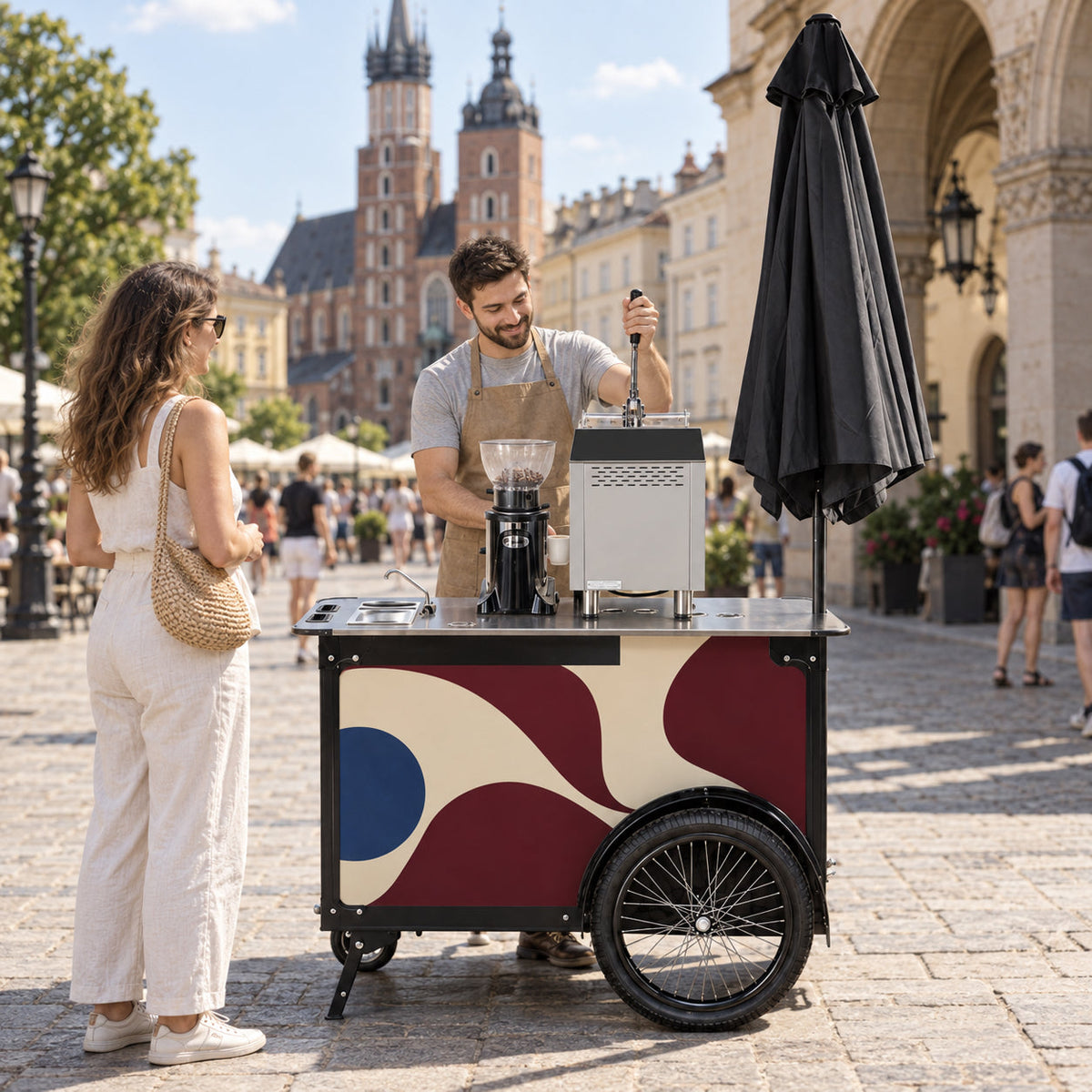
At its simplest, a coffee cart business is a compact, mobile coffee stand fitted with an espresso machine, grinder, refrigeration and water system. What makes it strategically interesting is not the hardware, but the operating model. Instead of committing to a high-rent fixed location, you trade square meters for flexibility: the same cart can serve office workers in a business park on weekdays, students on a university campus, tourists at a weekend market, and fans outside a stadium at night. Verified Market Reports estimates the global coffee cart market at roughly $4.5 billion in 2024, with steady growth expected through 2033.
While those numbers are small compared with the massive coffee shop sector, they reflect a format that is still underpenetrated relative to demand. For operators partnering with specialist manufacturers such as BizzOnWheels, which builds branded mobile business platforms and coffee bikes
The economics are what turn curiosity into conviction. Traditional bricks-and-mortar cafés routinely require six-figure investments once you include fit-out, equipment and working capital, and coffee trucks often demand $60,000 to $100,000 or more in upfront spend. By contrast, coffee cart startup costs can start in the tens of thousands of dollars, depending on how custom you go and whether you buy new or used equipment. Some equipment vendors estimate all in ranges of roughly $24,000 to $49,000 for a professional-grade setup. On the revenue side, industry analyses suggest that coffee cart profit margins often land in the 60–80% range, thanks to low ingredient costs for espresso-based drinks.

You are trading scale for efficiency: fewer seats, a smaller menu and tighter labor, but fast lines and high-margin beverages. If you can consistently serve 80–100 drinks per peak window, plus upsell a modest basket of pastries or snacks, a well-positioned cart can rival the daily gross of a much larger coffee stand.
Before anyone pulls a shot, however, the boring part compliance has to be handled like a pro. Mobile food vending is heavily regulated, and although a coffee-only menu is often treated more lightly than hot food, you should expect to need some combination of business license, health permit, mobile food vending permit and proof of food-safety training, plus the cart itself may be inspected like any other food establishment. Health departments from New York to California treat carts as mobile food facilities that must meet construction guidelines, water and wastewater capacities, and hygiene protocols, with annual permit renewals and pre-opening inspections baked in.
Many jurisdictions also require a commissary an approved commercial kitchen where you refill water, store ingredients and clean equipment although some specifically exempt limited-menu units like espresso-only carts if all storage, prep and cleaning can be done on board.
The headline for founders is simple: your first call should not be to a cart fabricator; it should be to your local health department and business licensing office, because licensing rules can influence everything from your cart’s layout to where you’re legally allowed to park.

Once you know you can operate, the real work begins: research. Coffee is now infrastructure for urban life, and consumer expectations have evolved accordingly. Recent National Coffee Association data shows that 46% of American adults had specialty coffee in the past day, up more than 80% since 2011, with 25 to 39 year olds leading the charge. Meanwhile, research groups tracking coffee market trends highlight “speed, convenience, and innovation” as core drivers of modern coffee rituals.
That means you’re not just asking, “Who likes coffee?” You’re mapping micro segments commuters who want frictionless espresso, students willing to wait for single origin pour overs, tourists looking for Instagram-ready latte art, or event goers hunting for a quick flat white between sets. A serious founder spends weeks observing patterns at potential locations, watching not only how many people pass, but who stops, what they already carry, and whether they look like they’d happily cross the street for a better cappuccino.
Location, in this game, is both a blessing and a variable. Fixed cafés live or die on foot traffic; studies on café site selection repeatedly show that high-visibility locations with dense flows of pedestrians or cars significantly boost the odds of success.
A mobile coffee cart tilts the equation. You have the freedom to test multiple pitches a business park in the morning, a farmers’ market or outdoor concert on weekends, parking lots outside big box stores during holiday peaks. At the same time, you inherit new constraints: some landlords will grant exclusive rights to a single coffee vendor; some city centers tightly regulate where pushcarts can trade; some events will already be locked up by large beverage sponsors. Operators who treat their cart like a portfolio asset, systematically testing spots, tracking hourly sales and negotiating recurring placements with property owners, outperform those who simply show up in the most obvious plaza and hope for the best. For founders using highly mobile formats such as a branded coffee bike , it becomes even easier to “follow the heat,” shifting location with weather, festivals and office return-to-work patterns.
Your menu, meanwhile, is not just a list of drinks; it’s your operating system. The choice between a tight, espresso-led offering and an extended lineup of cold brew, flavored lattes, alternative milks and seasonal signatures will determine the complexity of your equipment, the speed of your line and your average ticket. Analysts tracking 2026 specialty coffee trends note surging interest in functional additions (such as mushroom coffee), single-origin espresso and creative seasonal drinks that drive social buzz think pumpkin-spice style “halo effects” that can lift traffic by more than 20% when executed well.
For a cart, the art lies in offering just enough variety to feel modern an excellent house espresso, a small roster of milk-based drinks, a strong iced or cold brew option, plus one or two signature creations without bogging down a tiny service space. Supplier strategy follows from there: locking in stable contracts for beans, milk, pastries and disposables isn’t glamorous, but in a high-volume coffee stand your lids, cups and napkins will quietly become one of your biggest monthly line items.
At some point the spreadsheet has to meet reality. A credible coffee cart business plan does more than list optimistic daily sales; it sets out capital expenditures, operating costs, pricing strategy and break-even volumes with the same discipline as any serious retail venture. Coffee shop financial guides suggest that even small cafés can spend $1,000 or more per month on utilities alone, on top of rent and payroll.
A mobile unit sidesteps much of that fixed overhead, but you add other items: generator fuel or batteries, commissary fees, maintenance, event pitch fees, insurance and possibly storage. From there you reverse-engineer your pricing. With cart-level profit margins in the 60–80% range before overhead, you can model different volume scenarios: Can you hit your break-even point with a single strong morning and a smaller lunchtime push, or do you need evenings and weekend events as well? That exercise also reveals whether you are building a side hustle that fits around another job, or a full-time operation that will eventually justify a small fleet of carts or coffee pop up units
Marketing for a coffee cart in 2026 is no longer limited to a chalkboard and a smile, though both still help. Coffee brands that win with younger consumers do so by blending physical presence with digital storytelling social media, local search optimization, and loyalty programs that live on the phone your customer is already holding. Recent café marketing playbooks push short-form video on Instagram and TikTok, digital loyalty schemes and partnerships with micro-influencers as core tactics.

Academic research on the coffee industry shows that social media and electronic word-of-mouth significantly shape Gen Z’s loyalty to coffee brands, as digital trust becomes a precursor to repeat visits.
For a mobile operator, that translates into very practical actions: claim and optimize your Google Business profile, encourage reviews, document your daily route in Stories, and make sure your cart especially if it’s a visually distinctive coffee bike or branded coffee kiosk is photogenic enough that customers want to share it. Word-of-mouth remains the most trusted channel: one recent guide notes that roughly a quarter of consumers rely on personal recommendations when choosing cafés, which makes every interaction at the cart a potential micro-advertisement.
Underneath the tactics, the most successful coffee cart founders have something harder to quantify: a clear vision for what they’re building. Some are explicit about wanting a lean, lifestyle-compatible business they can park outside a club on Friday nights and at a farmers’ market on Sunday mornings. Others treat the first cart as a prototype a proof of concept on the way to a multi-unit mobile fleet, or even to a permanent café once the brand has traction. In both cases, clarity matters. Setting explicit goals daily revenue targets, number of recurring pitches, timeline to hire the first barista turns vague ambition into an operating roadmap. And because the format is inherently flexible, you can evolve: a simple coffee cart today, an extended coffee stand with a larger footprint tomorrow, a branded coffee pop up at festivals the year after that, all powered by the same core idea and, ideally, the same carefully designed cart platform.
If you strip away the romance, a coffee cart is a compact piece of commercial real estate on wheels, rented not by landlords but by time and attention. If you respect the regulations, do your homework on location and competition, invest in high-quality equipment, design a tight menu and tell your story well, the unit will reward you with one of the most attractive combinations in small business: modest startup costs, strong gross margins and a product people are genuinely happy to buy every day. The work will be early, sometimes cold, occasionally chaotic. But for many founders, the moment that matters most isn’t the first profit-and-loss statement; it’s the first time a regular changes their route to find your cart, because they’ve decided your coffee, your service and your tiny mobile café are now part of their morning ritual.
References
https://www.ncausa.org/Newsroom/More-Americans-Drink-Coffee-Each-Day-Than-Any-Other-Beverage-Bottled-Water-Back-in-Second-Place
https://www.researchandmarkets.com/reports/5807049/coffee-global-market-report
https://www.verifiedmarketreports.com/product/coffee-cart-market/
https://www.7shifts.com/blog/starting-coffee-truck/
https://cart-king.com/cart-and-kiosk-articles/coffee-cart-startup-costs-complete-financial-guide-2025/
https://www.linkedin.com/pulse/coffee-cart-market-size-2026-ai-disruption-mm9we/
https://www.ncausa.org/Newsroom/Specialty-coffee-consumption-hits-14-year-high
https://www.gourmetpro.co/blog/coffee-market-trends-expert-insights
https://www.nyc.gov/site/doh/business/food-operators/mobile-and-temporary-food-vendors.page
https://deh.santaclaracounty.gov/food-and-retail/compliance-retail-food-operations/apply-permit-mff
https://tpchd.org/professionals/food-safety/permits-and-applications/mobile-food-units/
https://metrobi.com/blog/location-for-coffee-shop/
https://baristalife.co/blogs/blog/coffee-shop-location-analysis
https://tastewise.io/blog/specialty-coffee-trends
https://www.marketwatch.com/story/customers-are-rushing-to-coffee-shops-like-starbucks-dunkin-thanks-to-the-pumpkin-spice-latte-halo-effect-1867e34b
https://www.restroworks.com/blog/coffee-shop-startup-costs/
https://foodhubforbusiness.com/blogs/cafe-marketing-strategies-2025/
https://www.researchgate.net/publication/377040110_The_effect_of_social_media_and_electronic_word_of_mouth_on_trust_and_loyalty_Evidence_from_generation_Z_in_coffee_industry
https://www.beansandbrews.com/franchise/blog/marketing-strategy-for-a-coffee-shop/