Artikel: How to Launch a Successful Mobile Food Cart Business in 2026
How to Launch a Successful Mobile Food Cart Business in 2026
What if the secret to dominating the $250 billion global street food market isn't a massive engine, but a more agile, eco-friendly footprint? Many entrepreneurs believe that a six-figure motorized truck is the only path to success, but the reality of 2026 tells a different story. You've likely felt the sting of rising overhead and the headache of complex urban parking regulations. It's common to fear that a smaller mobile food cart might get lost in the crowd, or that local red tape will stall your progress before you even make your first sale.
We understand these challenges because we've helped pioneers across 75 countries bypass the traditional barriers to entry. This guide will help you master the strategic steps to launching a high-visibility, eco-friendly mobile vending business with professional-grade equipment that commands attention. We'll provide a clear roadmap from your initial concept to that first profitable transaction. You'll learn how to select the right cart type for your specific menu, navigate the regulatory landscape with confidence, and use custom branding to ensure your business remains the main attraction in any crowded urban environment.
Key Takeaways
- Understand why a mobile food cart is the most strategic entry point for 2026, offering significantly lower overhead and greater agility than motorized alternatives.
- Identify the ideal platform for your menu by comparing the robust capabilities of premium food carts against the specialized mobility of coffee bikes.
- Learn how to navigate complex local vending regulations and secure high-visibility locations that guarantee consistent foot traffic.
- Discover how professional custom wrapping transforms your unit into a powerful brand statement that attracts customers through smart design and color psychology.
- Master the "A to Z" process of launching your venture, ensuring your equipment is built for professional-grade durability and shipped ready for immediate operation.
Why a Mobile Food Cart is the Smartest Business Entry Point in 2026
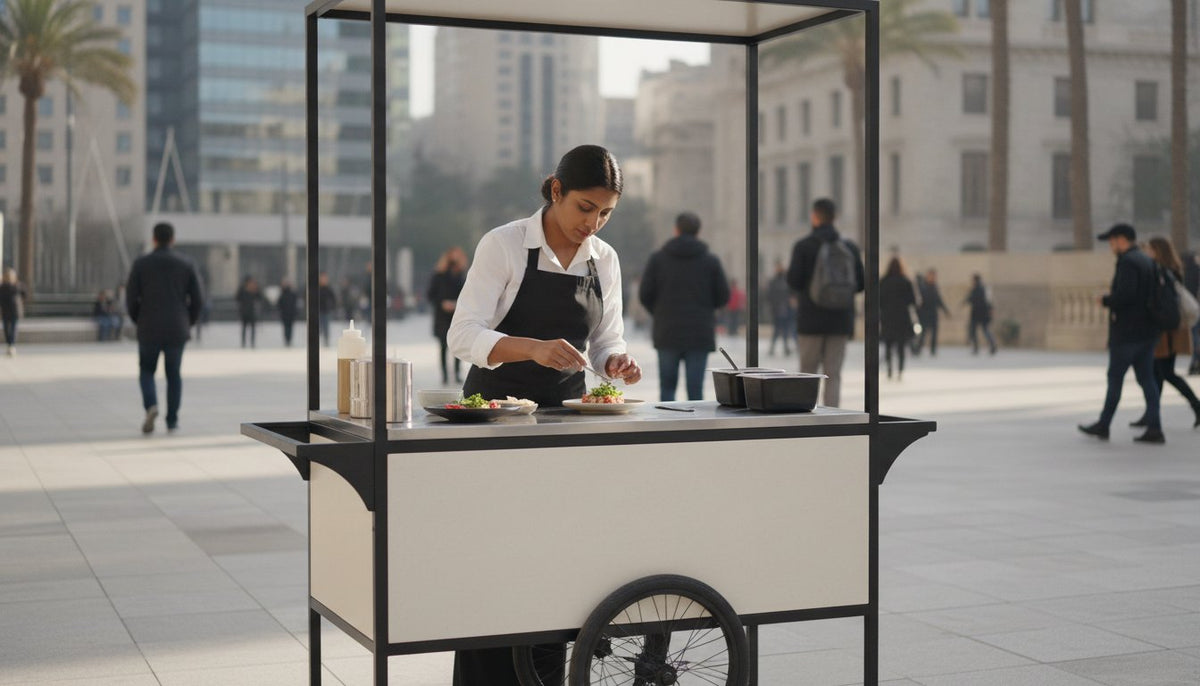
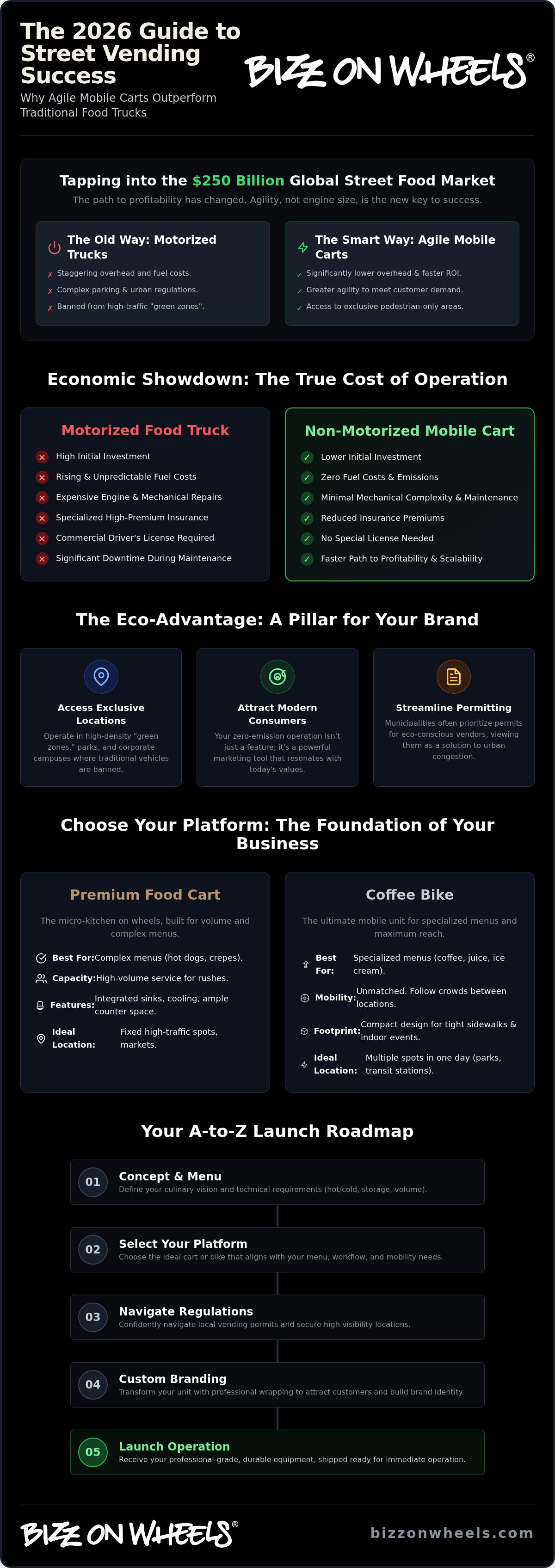
The landscape of street commerce has shifted. While the era of the massive, gas-guzzling food truck continues, its dominance is being challenged by a leaner, more intelligent alternative. Enter the mobile food cart. It is no longer just a simple stand; it is a high-agility commerce platform designed for the modern urban environment. Agile commerce is defined as the ability to pivot locations instantly to meet shifting pedestrian demand.
This shift is driven by necessity. Many cities are implementing "green zones" where motorized vehicles are strictly prohibited. By choosing a non-motorized unit, you gain access to high-density pedestrian areas that your competitors simply cannot reach. Understanding the history of food carts reveals that their success has always been rooted in this fundamental proximity to the customer. Today, that proximity is more valuable than ever.
The Economic Advantage of Non-Motorized Units
The financial barrier to entry for a motorized food truck has become staggering. Between specialized insurance, rising fuel costs, and constant mechanical maintenance, the overhead can suffocate a new business before it scales. Non-motorized units offer a radical alternative. You eliminate the need for a commercial driver's license, expensive engine repairs, and high-premium vehicle insurance. This lean operational model creates a faster path to ROI. Efficiency also enables rapid scalability through several key advantages:
- Lower initial investment allows for purchasing multiple units simultaneously.
- Reduced insurance premiums and zero fuel costs protect your monthly cash flow.
- Minimal mechanical complexity reduces downtime and maintenance expenses.
Sustainability as a Brand Pillar
Modern consumers in 2026 aren't just buying food; they're buying into values. A business that operates with zero emissions is a powerful marketing asset. It positions you as a responsible partner in the urban ecosystem. This eco-conscious approach also streamlines the bureaucratic process. Many municipal governments prioritize permits for zero-emission vendors, viewing them as a solution to urban congestion rather than a contributor to it.
Being "green" isn't just a label. It's a strategic advantage that opens doors to private events, corporate campuses, and sustainable festivals that are increasingly banning traditional combustion engines. Your mobile food cart becomes a moving billboard for modern, responsible commerce.
Selecting Your Platform: Premium Food Carts vs. Coffee Bikes
Selecting your platform is the most critical decision in your entrepreneurial journey. It dictates your menu, your location, and your daily workflow. You must align your equipment with your culinary vision. A mobile food cart isn't a one-size-fits-all tool. It's a specialized instrument of commerce. High-quality design translates directly into operational efficiency.
When analyzing your menu, consider the technical infrastructure. Hot food requires integrated burners and ventilation. Cold storage demands high-grade insulation or active refrigeration. If you're planning for high-volume service, capacity planning is essential. You need enough storage to last through the lunch rush without constant restocking. Professional-grade materials like stainless steel are vital. They ensure food safety compliance and provide the durability needed for daily outdoor use. They also resist the wear and tear of urban environments, protecting your investment for years.
The mechanics of your unit also matter. Hand-pushed units provide unmatched precision for tight sidewalks and indoor venues. In contrast, bicycle-towed configurations allow you to cover more ground quickly. This mobility is perfect for vendors who move between parks and transit stations throughout the day. It allows you to follow the crowd as it shifts.
Premium Food Carts for High-Volume Vending
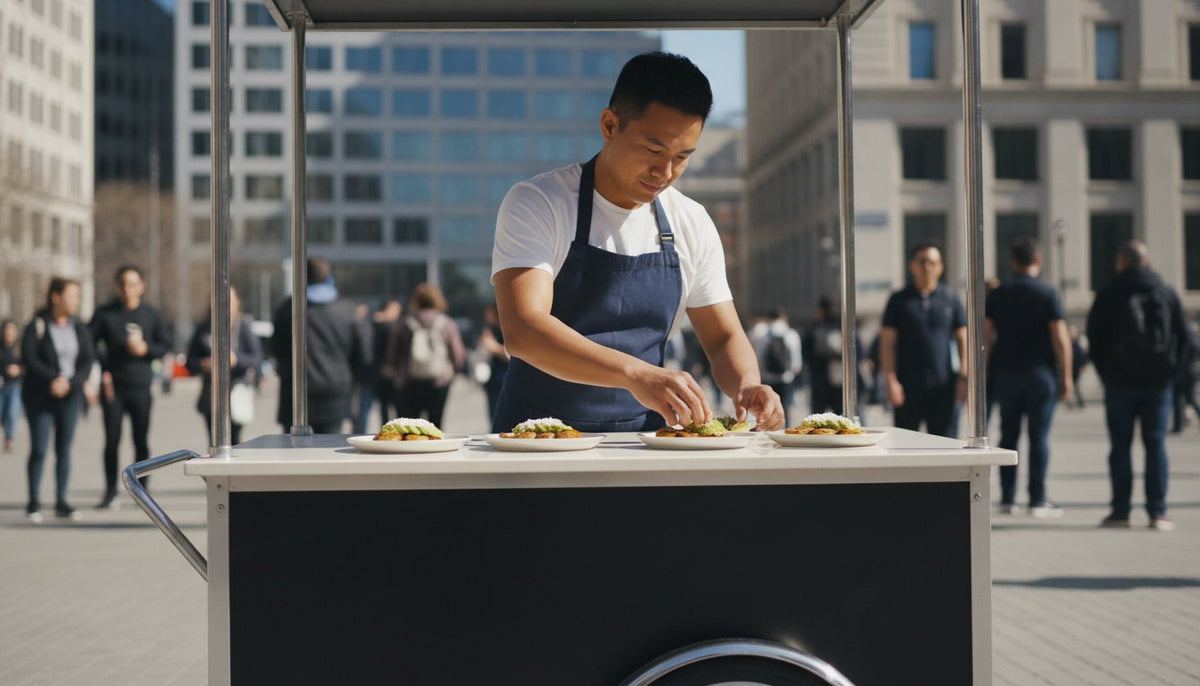
These units function as micro-kitchens on wheels. They're the gold standard for complex menus like artisanal hot dogs or fresh crepes. By maximizing counter space, you create an efficient assembly line for your products. This efficiency directly impacts your bottom line during peak hours. Integrating sinks and cooling systems isn't just a convenience; it's often a requirement under mobile food establishment regulations. A well-designed cart allows you to serve hundreds of customers with precision and speed. It handles the pressure of a busy festival without breaking a sweat.
Coffee Bikes: The Ultimate in Mobile Barista Service
The coffee bicycle has redefined the morning commute. These units excel in high-traffic urban hubs where speed and portability are paramount. Unlike stationary kiosks, a coffee bike allows you to position yourself exactly where the foot traffic is heaviest. Technical requirements for mobile espresso service are specific. You need reliable water pressure and consistent power for grinders and machines. These bikes are built to support professional espresso setups while remaining easy to maneuver through pedestrian zones.
Choosing between these platforms depends on your operational style. Do you want the robust capacity of a mobile food cart or the nimble speed of a bike? Both paths offer a professional entry into the market. If you're ready to see how these designs look in action, you can explore customized mobile vending solutions tailored to your brand. Professionalism in your equipment builds immediate trust with your customers. It transforms a simple purchase into a premium experience.
Navigating the Logistics: Permits, Locations, and Operations
Logistics are the engine of your business. While the hardware provides the potential, your operational strategy determines the profit. A mobile food cart offers a distinct advantage here: simplicity. Unlike massive trucks, these units often fall under different regulatory categories that can streamline your path to the sidewalk. You must start by researching your local health department codes. These regulations typically focus on temperature control, surface materials, and waste management. Understanding these requirements early prevents costly mid-season adjustments.
Efficiency in a compact space is an art form. You don't have the luxury of a 20-foot kitchen, so your menu must be focused. A limited, high-quality menu reduces waste and speeds up service. It also simplifies your daily operational checklist. Every morning should follow a precise rhythm. Equipment sanitization, ingredient prep, and a safety sweep are essential steps. Breakdown is just as critical. Thorough cleaning at the end of the day ensures longevity for your premium equipment and maintains professional standards. This discipline keeps your overhead low and your quality high.
Securing Your Vending Rights
Vending rights vary significantly between public streets and private property. Public spaces often require specific permits or lottery-based spots. Private events, such as corporate lunches, weddings, or community festivals, offer a more controlled environment with guaranteed income. Success requires managing these differences with professional poise. Regardless of the venue, safety is non-negotiable. Your setup must include a fire extinguisher and a comprehensive sanitation kit. Insurance for 2026 should cover general liability and product coverage to protect your growing enterprise from unforeseen risks.
The "Prime Spot" Strategy
Location isn't just about being where people are. It's about being where people are ready to buy. Use foot traffic data to identify transit hubs, parks, and festival entrances. High-yield spots are often found at the intersection of convenience and necessity. To cut through the noise of a crowded urban space, you can utilize mobile billboards. Tools like the AdBicy system can announce your presence blocks before a customer even sees your unit. It creates a radius of awareness that stationary competitors lack.
Once you find a high-yield coordinate, stick to it. Consistency builds "Location Loyalty." Customers will start looking for you at a specific time if they know you'll be there. This reliability transforms a passing pedestrian into a recurring revenue stream. Your mobile food cart becomes a landmark in their daily routine, providing a professional and dependable service that outshines less organized vendors.
Turning Wheels into a Brand: The Power of Custom Cart Wrapping
On a crowded street, your mobile food cart has exactly three seconds to capture a pedestrian's attention. Visual identity isn't just a design choice; it's your most aggressive marketing tool. While high-quality equipment provides the foundation, the exterior branding tells the story of your food's quality and your brand's personality. It acts as a silent salesperson that works even when you're busy serving customers.
Psychology plays a massive role in street vending success. Warm tones like red and orange can stimulate appetite, while clean whites and greens signal freshness to health-conscious urbanites. A professionally designed wrap signals to the customer that your operation is established and hygienic, instantly increasing perceived value and building consumer trust. This visual "handshake" often happens long before the customer smells your menu or sees your prices. It transforms a piece of equipment into a destination.
Designing for Distance and Impact
Impact requires clarity. Your logo and primary product must be legible from at least 50 feet away to pull customers from across the street. In 2026, your cart must also bridge the gap between physical and digital commerce. Integrating high-contrast QR codes and social media handles into the wrap allows passersby to follow your schedule or view your menu instantly. Consistency is the key to memory. Ensure your cart's color palette matches your staff uniforms and digital presence to create a seamless brand experience that builds recognition over time.
The Turnkey Customization Process
The most efficient way to achieve this look is through a turnkey manufacturing partner. When branding is handled in-house, the design is perfectly calibrated to the mobile food cart's specific dimensions and curves. This eliminates the risk of misaligned graphics or peeling edges that often plague third-party installations. Custom vinyl wrapping also serves a practical purpose. It acts as a protective shield for the professional-grade materials underneath, guarding against UV rays and minor abrasions. To keep your brand looking fresh, follow a simple maintenance routine:
- Use pH-neutral soaps and soft microfiber cloths for daily cleaning.
- Avoid high-pressure water streams that can lift the edges of the vinyl.
- Park in shaded areas when possible to minimize long-term UV exposure.
Regular maintenance ensures your investment continues to sell for you year after year. If you're ready to transform your vision into a high-impact reality, explore our custom cart wrapping services to see how we bring mobile brands to life. Professionalism in your presentation is the fastest way to scale your street presence.
Launching with Bizz On Wheels: From Concept to Global Delivery
Since 2010, Bizz On Wheels has acted as a pioneer in the mobile commerce industry. We don't just manufacture units; we scale visions. Our legacy is built on fifteen years of iterative innovation and a commitment to professional reliability. Whether you are a new entrepreneur or a seasoned business owner, our team acts as a professional partner throughout your entire journey. We've successfully shipped our products to over 75 countries, proving that the demand for high-quality, eco-conscious vending is truly global. This extensive reach has given us unique insights into diverse urban markets and regulatory environments.
The "A to Z" manufacturing process is the heartbeat of our quality control. Every mobile food cart we build undergoes rigorous testing within our own facilities. By handling everything from the initial frame construction to the final custom wrap in-house, we eliminate the variables that lead to equipment failure. This integrated approach ensures that when your unit arrives, it is ready for immediate commercial use. We manage the complexities of global logistics so you can focus on your launch.
Quality Craftsmanship You Can Trust
Our design studio is a space where real-world feedback from vendors across the globe shapes every hinge and storage compartment. We prioritize the durability of stainless steel and premium components because we know your business depends on uptime. Your equipment needs to withstand the rigors of daily urban vending while maintaining a premium aesthetic. This focus on craftsmanship allows your business to grow seamlessly. Many of our clients start with a single unit and quickly expand into a mobile fleet as they master their local markets.
Getting Started Today
Our experts are ready to consult with you to match the perfect mobile food cart or coffee bike to your specific business goals. We'll help you navigate the practicalities of personalization and provide a clear timeline from your initial order placement to global delivery. Requesting a quote is the first step in your custom design journey. Your future in mobile commerce is closer than you think.
Explore our Premium Food Carts and start your journey today and join a global network of successful street entrepreneurs.
Take the First Step Toward Your Mobile Commerce Legacy
Success in 2026 isn't about having the largest vehicle; it's about having the smartest strategy. By choosing a high-agility mobile food cart, you bypass the heavy overhead of motorized trucks and gain access to the most lucrative pedestrian zones in your city. You've seen how the right platform, paired with meticulous operational planning and high-impact custom wrapping, transforms a simple idea into a professional brand that customers trust at first sight.
We've been at the forefront of this movement since 2010. With experience shipping to 75+ countries and providing turnkey branding and installation, we're ready to act as your partner in growth. Your vision deserves the reliability of premium craftsmanship and the visibility of modern design. It's time to stop planning and start serving your community with a business that reflects your ambition. Start Your Mobile Business with a Professional Bizz On Wheels Cart and join a global network of innovators who are redefining street food. The sidewalk is waiting for your next big move.
Frequently Asked Questions
Do I need a driver’s license to operate a mobile food cart?
Generally, you don't need a driver's license to operate a non-motorized unit. This is a primary reason entrepreneurs choose this model over traditional food trucks. Because our carts are either hand-pushed or bicycle-towed, they don't require the same licensing as motorized vehicles. You should still check your local municipal codes regarding bicycle usage on public roads. This simplicity allows you to launch your business without the burden of expensive vehicle certifications or specialized licensing.
How much does it cost to start a mobile food cart business in 2026?
Startup costs depend on your specific menu and equipment requirements. While a motorized truck can often cost over $200,000, a professional mobile food cart offers a much lower barrier to entry. You'll need to account for the unit itself, initial inventory, and local permit fees. This lean operational model lets you invest more in your brand's visual identity and high-quality ingredients, which are the real drivers of long-term street-level success.
Can I customize the interior equipment of my Bizz On Wheels cart?
Yes, we prioritize flexibility in our manufacturing process to ensure your unit fits your specific workflow. Whether you need specialized cooling for an ice cream business or high-pressure water systems for a coffee bike, we can align the build with your menu. This bespoke approach ensures every square inch of your workspace is optimized for efficiency. We work closely with you to integrate the professional-grade tools you need to serve customers quickly and safely.
What are the best foods to sell from a mobile cart for high profit?
High-margin items with fast prep times are ideal for maximizing your daily revenue. Specialized coffee, artisanal ice cream, and gourmet street foods like crepes or tacos are consistently profitable choices. These items allow for high transaction volume during busy lunch hours or evening festivals. Focus on a niche menu that uses premium ingredients to justify your pricing. This strategy keeps your inventory manageable while building a strong, recognizable brand in a crowded urban market.
How do I handle electricity and water on a mobile bike cart?
Modern units use integrated battery systems and pressurized water tanks to operate independently from external hookups. For our coffee bikes, we install professional pumps and filtration systems to maintain high standards of espresso quality. Electricity is typically managed through high-capacity lithium batteries or quiet portable generators depending on your power draw. This setup gives you the freedom to position your business in high-traffic parks or transit hubs where traditional power sources aren't available.
How long does shipping take for international orders?
We have successfully delivered our units to clients in over 75 countries since 2010. Shipping timelines vary based on your global location and the level of customization required for your build. Once the manufacturing and custom wrapping phases are complete, we coordinate with trusted logistics partners for safe transport. Our team provides comprehensive tracking and handles the necessary export documentation. We ensure your equipment arrives ready to begin its commercial journey in your local market.
Is custom wrapping included in the purchase of a cart?
Custom branding is a specialized service we provide to ensure your mobile food cart stands out from the competition. While it involves a separate fee for design and installation, the turnkey nature of our in-house process is a major advantage. Our team handles the entire application to ensure a professional, durable finish that protects your equipment. A high-quality wrap is your best marketing tool, instantly building trust and increasing the perceived value of your products.
What permits are typically required for street vending in urban areas?
Permit requirements vary by city, but you'll typically need a mobile food facility permit and a standard business license. Most urban areas also require a seller's permit and a signed agreement with a licensed commissary kitchen for food storage and prep. If your menu involves heating elements, a fire department operational permit is often mandatory. You should consult your local health department early in the process to ensure your unit meets all specific sanitation and safety codes.